The verdict
Four rules, in the order I apply them. Look at the jump, not the name, because the gap between the second and third category tells you more than any brochure does. Skip the middle, since a small suite is usually an expensive version of the entry room while the top villas are a different holiday altogether. Judge a category against the island rather than against the hotel's own ladder, because the top villa at one resort often costs what an entry villa costs at a better one. And count the square metres per dollar, because the difference is frequently enormous and almost nobody checks.
I learned the last one the hard way at Tanah Gajah. I booked a one-bedroom Club Suite rather than the one-bedroom Club Pool Villa, and the difference in price was not large. What I got was a lovely room at the back of the resort with nothing much to look at. What I walked past every single day were the villas with their view over the rice fields. Eighty square metres against two hundred and twenty, for a gap I could have closed without much thought. I have checked the square metres on every booking since, which tells you how long that one stayed with me.
How do you know whether an upgrade is worth it?
Look at the jump in price, not at the name of the category. If the three cheapest rooms run to $250, $275 and $360, the middle one is almost never the answer. Twenty-five dollars buys a slightly better view of the same garden, while the step after it usually buys something structural: a different building, a different wing, a pool, a terrace that gets sun.
W Bali is the cleanest example on the island. The base rooms are not cheap at roughly $300 to $350, and a one-bedroom villa with its own pool sits around $500. For that gap you get 225 square metres in a quiet garden, which at a hotel built around a pool party is not simply a bigger room. It is a different holiday on the same site, for about forty per cent more.
So should you always reach higher?
No. Skip the middle, and either stay at the bottom or go properly to the top. The uncomfortable version of this lesson is mine. At The Apurva Kempinski I booked a suite and it was good without ever being more than that: comfortable, well finished, unremarkable against the standard the lobby had already set. The plunge pool sat too deep in shade to warm up and we used it twice in four nights. The entry room would have been the smarter booking, and the difference belonged in dinner.
The same logic works across hotels and not only within them. If you are about to book a suite at the Conrad, spend that money at the St. Regis instead, where the cheapest room in the resort is a 92 square metre suite with a butler attached.
And how do you know what a category is actually worth?
Compare it to what the same money buys elsewhere on the island. Samabe is the example I keep coming back to. The suites there are genuinely lovely, but upgrade to a villa and you are quickly paying double. For that sum you can have an entry villa at Raffles, at Soori or at Jumeirah, which is to say the cheapest room at a more exclusive address rather than the most expensive room at this one.
I would take the entry category at the better hotel almost every time. The catch is that you cannot see this on your first trip. It only becomes obvious once you have slept in enough of them to know what $900 looks like in four different places.
Is the entry category ever the best room in the hotel?
At the very top of the market, often yes. At Mandapa I stayed in a Reserve Suite, the entry category, and at 100 square metres it might be the best hotel room I have slept in on this island. At Amankila the suites vary enormously and it genuinely matters which one you take, so I deliberately chose a Garden Suite, the entry, stilted above the jungle with nothing in front of the terrace but green. At the Ritz-Carlton the entry suites start around 100 square metres for roughly $375, which is a serious amount of room before you have reached for anything grander. At Anantara Ubud, unless you specifically want your own pool, the entry suite is plenty.
The pattern is straightforward enough. The better the hotel, the less you need to climb.
Is a private pool worth paying for?
Only if you can swim in it and the sun reaches it. I am the wrong audience for most plunge pools, because I want enough water to take a few strokes and most of them are decorative. At Capella the tents sit so deep under the canopy that the pools never warm up. At Shore Amora ours ran so cold I never got past a toe. At Alila Villas Uluwatu I had a one-bedroom pool villa that is among the nicest rooms I have slept in anywhere, and by the third day the novelty of the pool had worn off, along with, to my genuine surprise, the view.
Then there is Kayumanis Jimbaran, the exception that makes the rule useful. Around $290 a night gets a 500 square metre villa with a pool big enough to be a pool, and a butler with it. That is the version worth paying for. Most of the others are set dressing.
What about paying for the view?
Check where the category actually sits before you pay for what it promises. At the Ritz-Carlton the ocean-view categories sit far enough back from the water that the view barely registers, which is the single correction I would make to anybody's booking there. At Jumeirah, meanwhile, our villa had no ocean view at all and I did not care in the slightest, because the vegetation around it was the entire point.
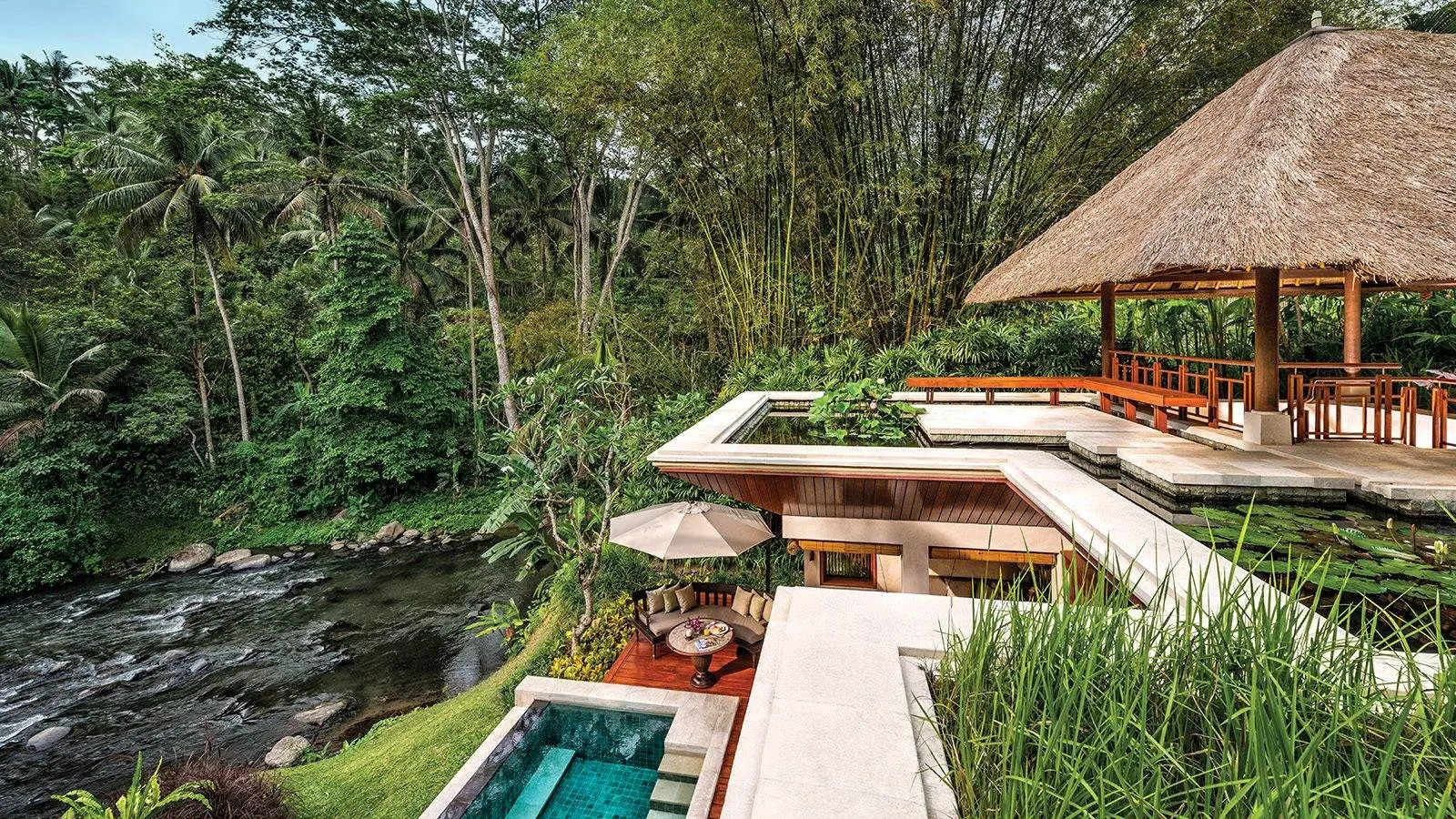
There is a noise version of the same trap. The expensive river villas at Four Seasons Sayan and Mandapa put you beside water that never stops, and it is constant and loud. Some people sleep better than they have in years. Others lie awake paying a premium for it. Know which one you are before you book one.
Does the room even matter for the trip you have planned?
Only if you are going to be in it. I once took the Uma Villa at COMO Uma Ubud, which was beautiful, and then filled the week so full that I barely spent any time there. Looking back it was money thrown away, not because the villa disappointed but because I had bought something I had no intention of using.
So the question to ask before you upgrade is a boring one, and it is the most useful in this article. How many waking hours will I actually spend in this room, and what will I be doing in them.
Does any of this change if you book through an advisor?
Yes, and it changes the starting position rather than the destination. Booking through Fora or any Virtuoso agency costs you nothing and normally attaches an upgrade on arrival, a resort credit and breakfast for two, at the same rate you would pay anyway. What it adds is a decent chance of waking up one category higher than you paid for, and that possibility should shape which category you pay for in the first place.
Where I know a hotel upgrades generously, I book one step below the room I actually want and let the hotel close the gap, because the credit arrives regardless. On this island that has been reliably true at Amankila, Amandari, Mandapa, COMO Shambhala Estate, COMO Uma Ubud, Anantara Ubud and the Ritz-Carlton, where you can reasonably expect both a room you did not pay for and $100 or more against food and spa.
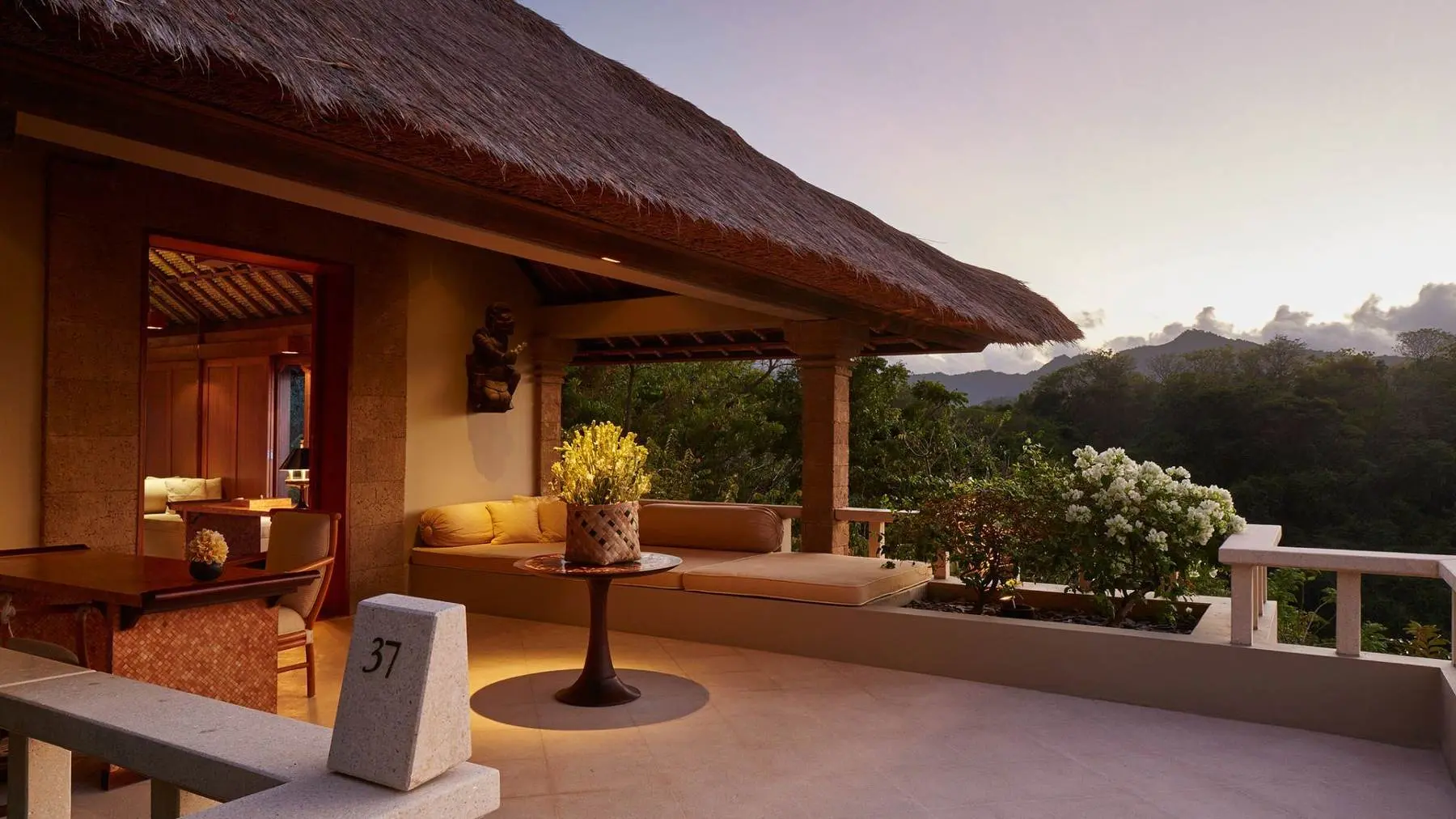
At The Oberoi, the St. Regis, The Laguna and both Four Seasons I would book the room I genuinely want and treat any upgrade as a bonus. The credit still comes, and at Four Seasons it is typically $100 on standard rooms and up to $200 on suites and villas. There is also less to climb at the St. Regis to begin with, since the cheapest room there is already a suite.
There is a pattern underneath this, and it is about scale rather than generosity. Aman and COMO are small groups where the person deciding your room is standing in front of you. Four Seasons, and Marriott's properties here including the St. Regis and The Laguna, are corporate operations where room assignment runs through a system rather than a conversation. That is why the small groups move you and the large ones hand you credit instead. The Ritz-Carlton is the exception that keeps this honest, since it belongs to Marriott and still upgrades well.
One caveat that applies everywhere. An upgrade from the very bottom of the ladder is usually the least valuable one, because the step from entry to second category tends to be the smallest step in the building. If you are going to play this game, play it from the middle rungs where the jumps are real.
What are you buying at the very top?
Not a bigger room. A different set of staff, and a different shape to the day. This is the part people misjudge, because they assume the top villas are the same suite with more marble in it. They are not. Somewhere around $2,500 a night the product quietly stops being a room and starts being a private household, and the finish has remarkably little to do with it.
In a normal room, however good, the hotel happens outside your door. You book a table, you walk to the restaurant, you take the spa slot that was free, you eat what the kitchen is cooking that night. At this level the direction reverses and everything comes to you. The chef builds a menu around what you like rather than what is printed. The masseuse arrives at the villa. The butler belongs to the villa rather than to the floor, and at dinner there may be a server who belongs to your table. You stop consulting the hotel’s schedule, because for a few days the hotel is quietly working around yours.
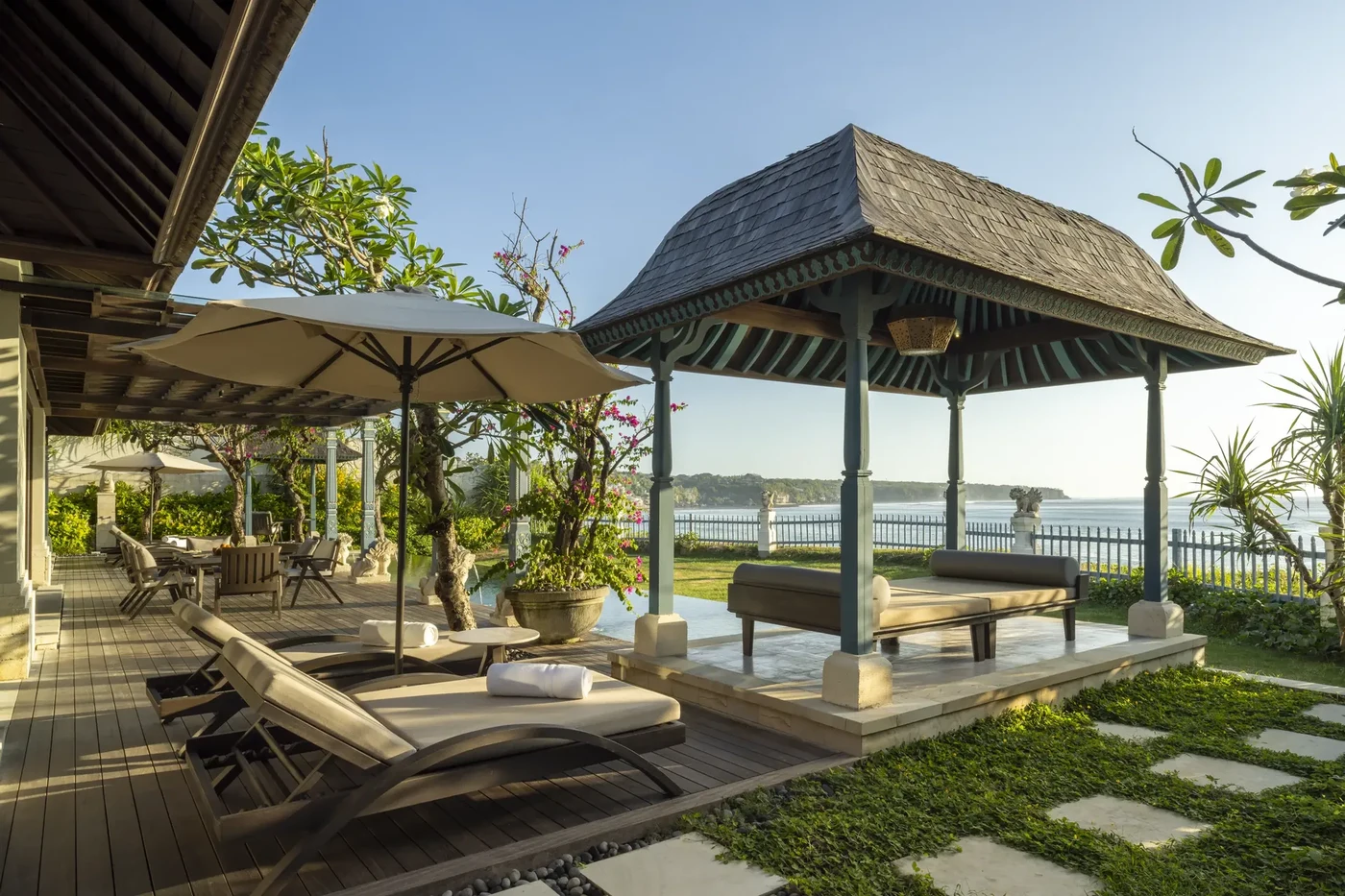
The clearest evening of this sort I have had ran that way from beginning to end. Thick wagyu steaks, lobster and scallops, cooked by a chef working in the villa, with a server looking after the table and the whole place strung with lights and flowers by the time we sat down. None of it appeared on a menu and none of it happened in a restaurant. It was a private barbecue in a garden that happened to belong to a hotel.
The other half of what you are buying is problem-solving with no price list attached. I once spent a day tracking down German Rieslings from the 1980s for a client who drank them, and had the bottles chilled and waiting in the villa fridge before he arrived. That is not a feature of the villa. It is a consequence of booking a category where somebody is expected to make that sort of thing happen.
Which is also the honest warning. If you plan to spend your days out of the room, at the beach club, in Ubud or on the road with a driver, you are paying for a household you will barely use and a good suite will serve you better. These categories earn their money when the villa becomes the venue rather than the bedroom.
What I would book, hotel by hotel
| Hotel | Book this | Skip this | Why |
|---|---|---|---|
| Mandapa | Reserve Suite, the entry, 100 sqm | Climbing at all, unless you want a pool | It may be the best hotel room on the island already |
| Amankila | Garden Suite, the entry | The middle of the ladder | Suites vary hugely here, and this one sits above the jungle |
| Tanah Gajah | One-bedroom Club Pool Villa, 220 sqm | One-bedroom Club Suite, 80 sqm | Small gap in price, enormous gap in space and view |
| W Bali | One-bedroom pool villa, around $500 | Base rooms at $300 to $350 | 225 sqm and quiet, at a hotel otherwise built around noise |
| The Apurva Kempinski | The entry room | The suite with the plunge pool | Ours sat in shade and we used it twice in four nights |
| The Ritz-Carlton | Entry Sawangan suite, 100 sqm, around $375 | Paying up for an ocean-view category | Those sit far enough back that the view barely registers |
| Kayumanis Jimbaran | The base villa, 500 sqm with pool and butler | Nothing. Start here | The rare private pool you can actually swim in |
| The St. Regis | The cheapest room in the resort | Reaching higher without a reason | It is already a 92 sqm suite with a butler attached |
| The Laguna | A lagoon-access room | The entry Deluxe at 36 sqm | The jumps between categories here are real ones |
| Anantara Ubud | The entry suite, 53 sqm | The villas, unless you want your own pool | Most of the day happens somewhere other than the room |
| Samabe | A suite, and stop there | The villas, at roughly double | That money buys an entry villa at Raffles, Soori or Jumeirah |
| Jimbaran Puri | A villa, ideally with a pool | The entry Garden View Cottage Suite | The craftsmanship of the place lives in the villas |
| Hyatt Regency | A base room plus the Regency Club | The suite categories | The value here is in what is included, not in floor space |
| Conrad Bali | An entry room on a sharp rate | The Conrad suite | Spend that difference at the St. Regis instead |
Based on our own paid stays. Categories, names and rates change, so treat this as a starting point and ask before you book.
You cannot know, on a first trip, whether a category is worth its price, because the only way to judge $900 is to have spent it four different ways. That is the whole reason this page exists, and the reason I keep the receipts.
Tell us the hotel and the dates, and we’ll tell you which category to book and what tends to come attached.
ASK BEFORE YOU BOOK →