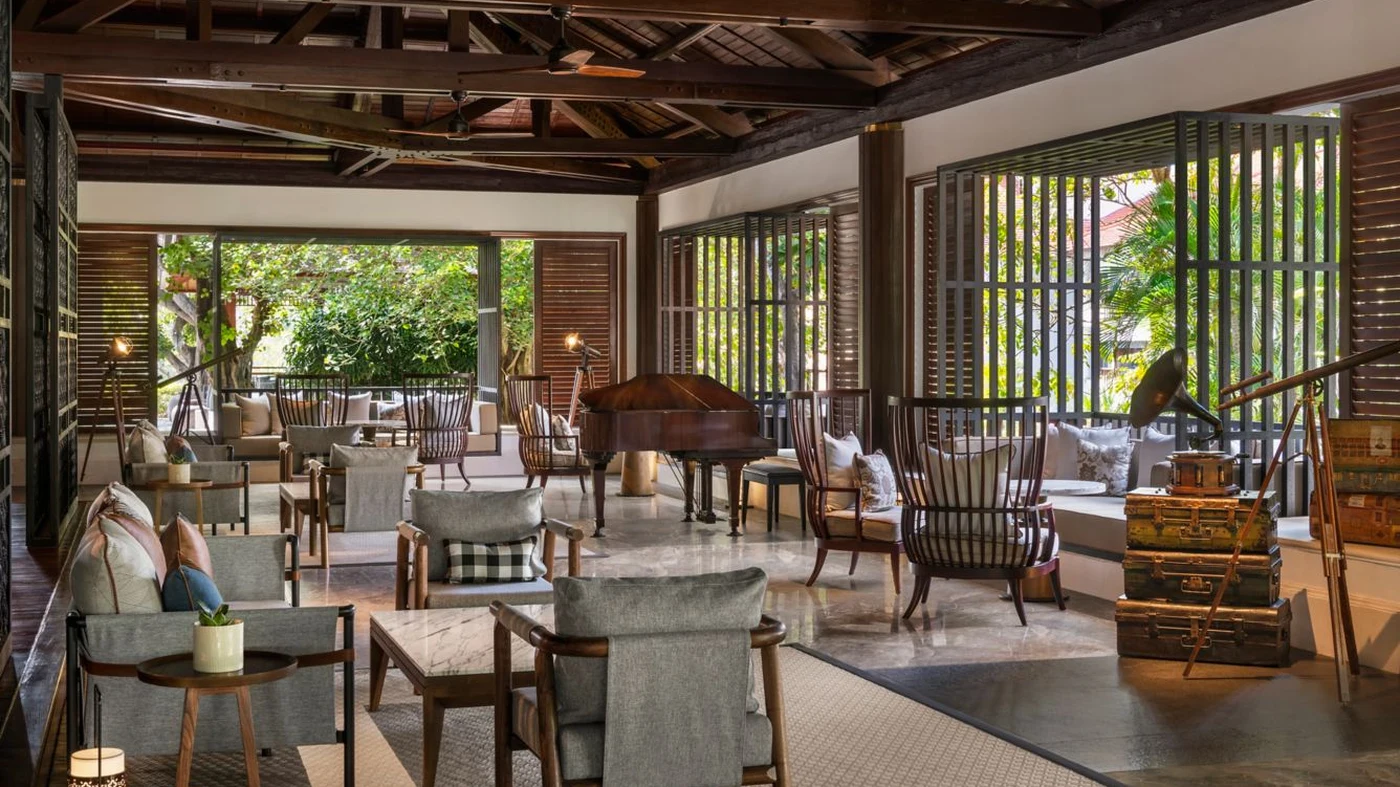
A friend of mine went to Nusa Dua on his first trip to Bali and came home saying he'd hated the place. He'd spent years dreaming about this island, and what he got looked nothing like any of it: a gated strip of enormous properties, manicured to within an inch of its life, with no particular reason to walk out of the gate and nothing much to walk to if you did.
That's the risk with this part of the island, and it's not a small one. Where you stay in Nusa Dua can make or break an entire trip to Bali, in a way it simply can't in Ubud or Seminyak. So I'll put my verdict up front rather than build to it: The Laguna is the one hotel here I recommend without hesitation, the most complete resort I've stayed in on this island, and the only property in Nusa Dua I actively daydream about going back to. It took me a while to work out exactly why.
Here's the first clue. There are guinea fowl wandering loose on the grounds. Nobody manages them, nobody explains them, and they are entirely unbothered by guests, which suggests they were here first and know it. My daughter spent most of one afternoon trailing one around a hedge at a respectful distance, and I sat watching her do it, thinking that somewhere in the development plan of every other property on this strip, a decision was made that birds are a liability.
Two hotels in Bali have surprised me over the past few years. One was the Hyatt Regency. The other is this one. Both share an origin story: an older resort, decades in, stripped to its bones and rebuilt rather than refreshed. I didn't expect that trick to work twice on the same stretch of coast.
Built for presidents, rebuilt for guests
The Laguna opened in 1991, built by the Rajawali Property Group as the first international resort in Nusa Dua, and spent three decades hosting the kind of guest list that included visiting heads of state. It also went thirty years without a proper renovation.
When Rajawali finally committed, in the middle of the pandemic, they didn't do it in one pass. The 287 rooms, suites and villas came first, in 2022. De Balé Lounge & Bar and Banyubiru Restaurant followed. Kulkul Beach House reopened that spring. Arwana, rebuilt entirely from the ground up, was the final piece, unveiled in mid-2023 and timed loosely around the G20 summit the resort helped host. Eighteen months, department by department, with no paint over old bones anywhere in it. Shirley Tan, who runs Rajawali, described the decision to start a full rebuild during a pandemic as a commitment to restore the place rather than wait for better conditions, and having seen the result, I believe her.
The design nobody talks about
This is the part I'd most want to correct in how The Laguna gets written about, because the coverage tends to stop at "seven lagoon pools" and move on. The design here is thought through to a level that almost nothing else in Nusa Dua attempts.
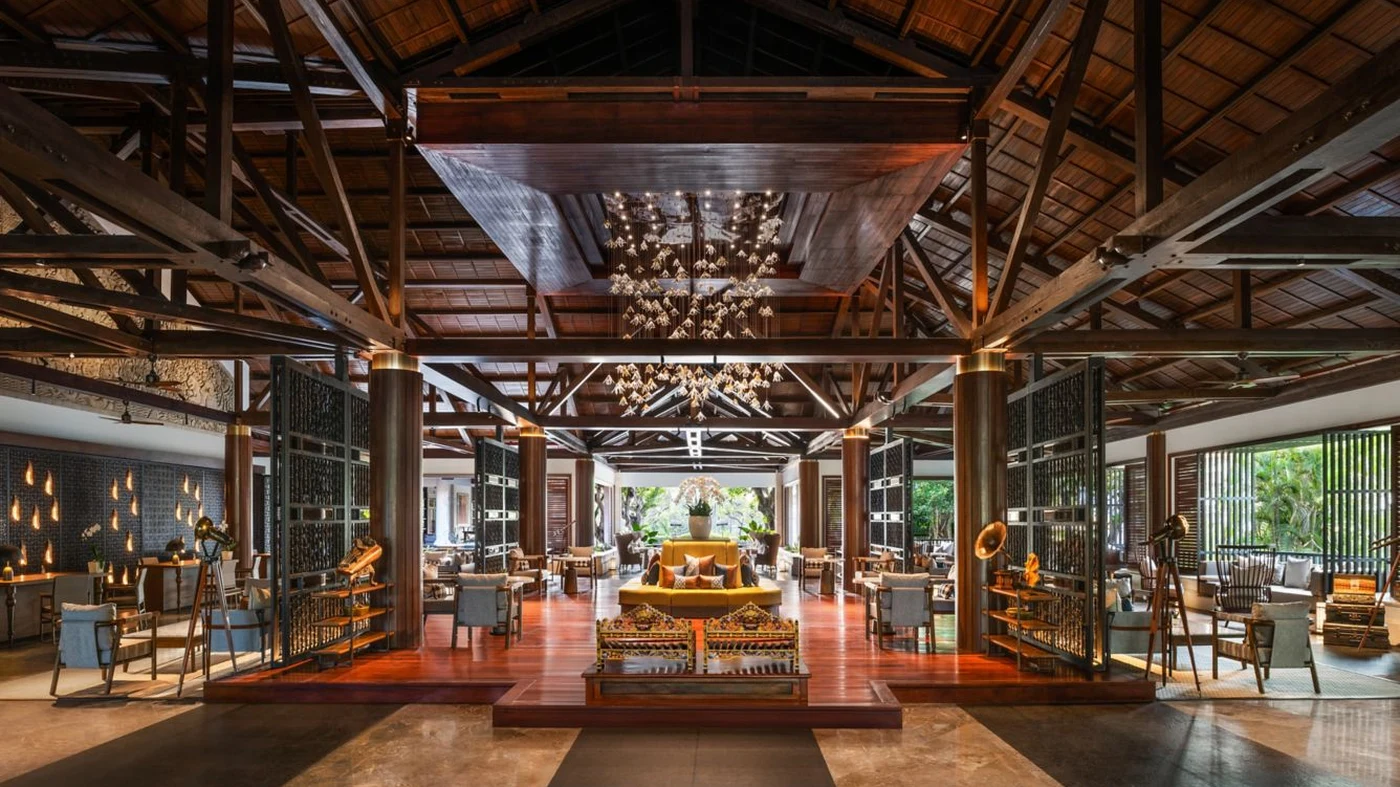
Start in the lobby, where a white stone carving above the check-in desk tells the story of Dewi Danu, the Balinese goddess of the lakes and waters. That isn't decoration chosen to look local; it's the organising idea for a resort built entirely around water, and once you've seen it you start noticing the same thought everywhere else. The rooms carry a panel of sulaman embroidery, the same needlework you'd find on a kebaya, worked into the headboard as the central feature. There are woven keben baskets, the ones used to carry temple offerings, and low dulang tables of the kind that hold fruit at a ceremony. Banyubiru, the all-day restaurant, was rebuilt in bamboo and rattan as a tribute to village warung stalls rather than as a hotel dining room that happens to serve Indonesian food.
And then there are the details that belong to the brand rather than the island: rope and leather detailing running through the rooms, shiplap walls, a bespoke set of lamps, and a leather suitcase standing next to the bed as a nod to travel and discovery, which is the thread Luxury Collection pulls through all its properties. It sounds like a lot written down. In the room it reads as one coherent idea, executed with restraint.
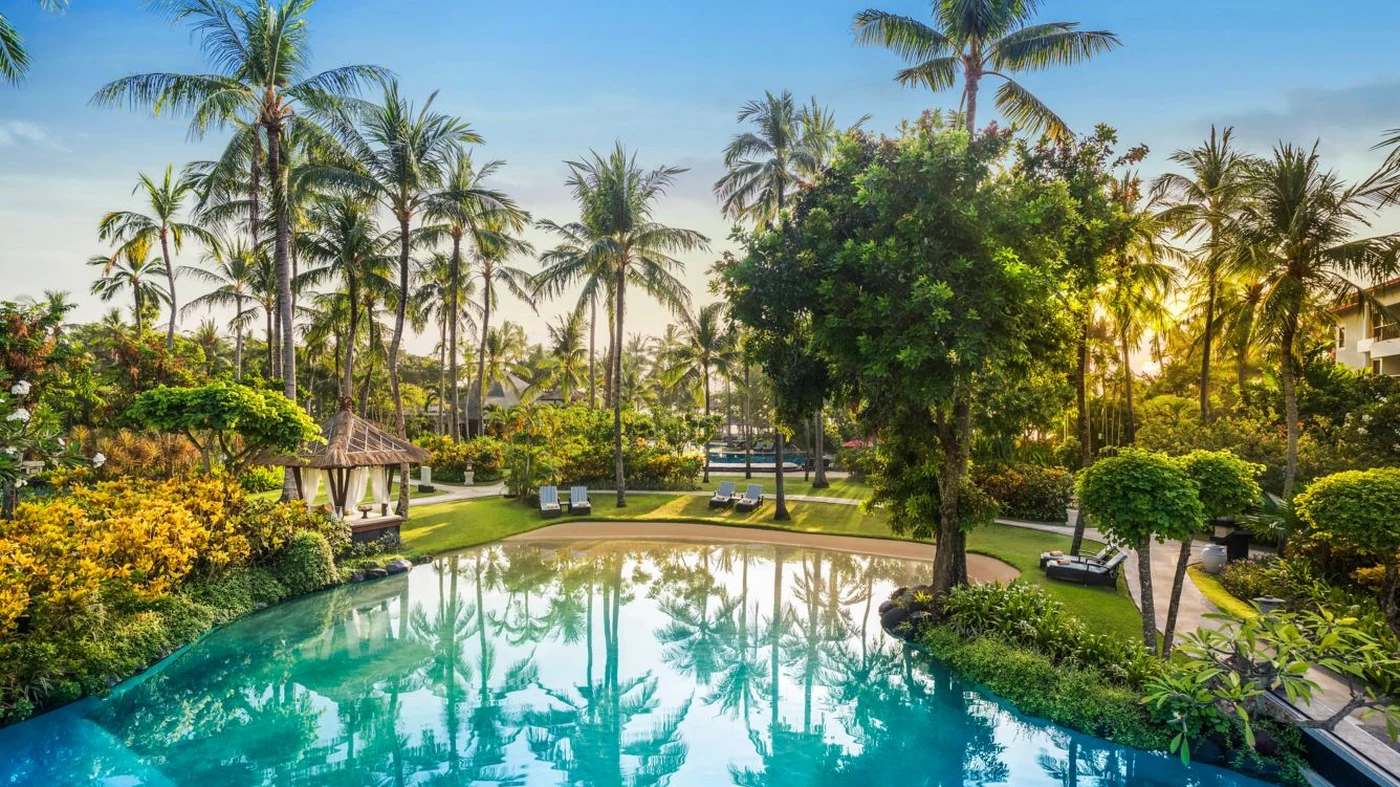
The gardens do the rest. They're lush to the point of density, statues at every turn, and the resort has its own temple sitting inside the grounds. It is, straightforwardly, one of the most beautiful hotels I've stayed in anywhere, and it earns that without a single view that could be called dramatic. The beauty here is all in the making.
Packed too tightly, and better for it
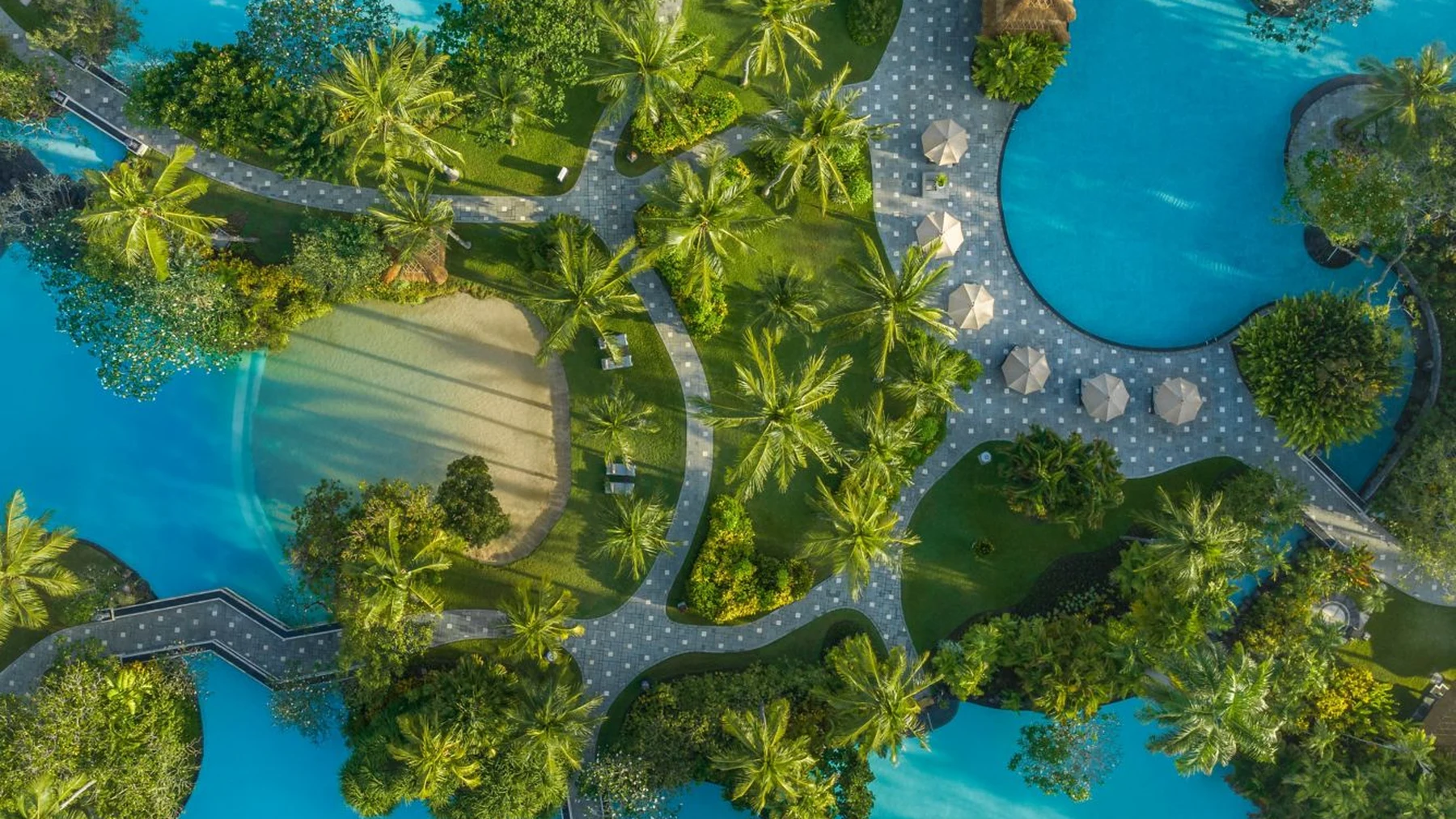
Seven lagoon-shaped pools thread through the property, one for each day of the week according to the brochure, and the whole thing is laid out far more densely than a resort of 287 rooms has any right to be.
Most hotels this size in Nusa Dua leave you wandering long stretches of manicured nothing to get from your room to anywhere worth being. The Laguna has been built too tightly for that logic to apply. Everything runs into everything else, the beach is compact and pressed up against the beachfront boulevard with a proper restaurant behind it, and you're never more than a few minutes from wherever you decide to go next. It shouldn't work at this scale. It's the single biggest reason the place feels like somewhere specific rather than a compound that could have been assembled anywhere warm.
The rest of the world is a five-minute walk away
Most of Nusa Dua's giants sit like private islands: nothing within walking distance, no reason to leave the gate, which the brochures tend to present as a feature. The Laguna is the exception. Bali Collection, the open-air shopping and dining strip, is a short walk away, and a long beachfront promenade runs right past the resort, worth wandering after dark for dinner or simply to stretch your legs.
Together they give the hotel something Nusa Dua otherwise struggles to produce: the sense that you're in a place rather than at a property.
Staff actively push you to go out and use all of it, and they mean it. Ask about the bikes and a polished one appears with chilled water bottles, no fuss, no forms. At Andaz the same encouragement gets offered at check-in and the rack is usually empty. Here the invitation is backed by actual bicycles, which sounds like nothing and is the difference between a policy and a habit.
What's actually going on here
The thread running through all of it is that this hotel is comfortable in its own skin, and that is very hard to fake.
After the guinea fowl afternoon, my daughter spent every low tide wading into the shallows hunting crabs. We walked the peninsula gardens more days than not, just to see them again. In the evenings, De Balé, built as a recreation of a Balinese village courtyard, seats you under bodhi trees with live music running most nights, and it's one of the most pleasant places to sit still that I've found on this island.
None of it reaches for the Instagram-hip aesthetic that every new hotel here now defaults to. Staff have worked here across generations and take visible pride in the place. Nothing about the warmth is performed, and it's generous without ever tipping into excess. The service isn't the best I've had in Indonesia and doesn't need to be. It's very good, consistently, and it fits the place exactly.
This is, by a distance, the most convivial hotel in Nusa Dua. That word matters more here than it would anywhere else on the island, because conviviality is the exact quality this part of Bali usually engineers out.
Rooms, suites and villas
The categories are unusually well spread here, and worth understanding before you book, because the jumps between them are real.
Entry-level Deluxe rooms run 36 square metres and look out over the gardens or a lagoon pool. The version worth paying up for is the Deluxe Lagoon Access, where a private balcony steps directly into the water. We stayed in one, freshly renovated, and it does exactly what it promises: you get out of bed, you're in a pool.
Above that, Executive and Lagoon Suites double the space to around 60 square metres, with a reception area, a separate dining room and a proper bedroom, which is where it starts feeling residential rather than roomy. The one-bedroom Laguna Pool Villas run to 360 square metres with private check-in and a pool of their own. At the top sits the Grande Lagoon Suite, a duplex of 390 square metres with antique Balinese furniture and its own private lagoon.
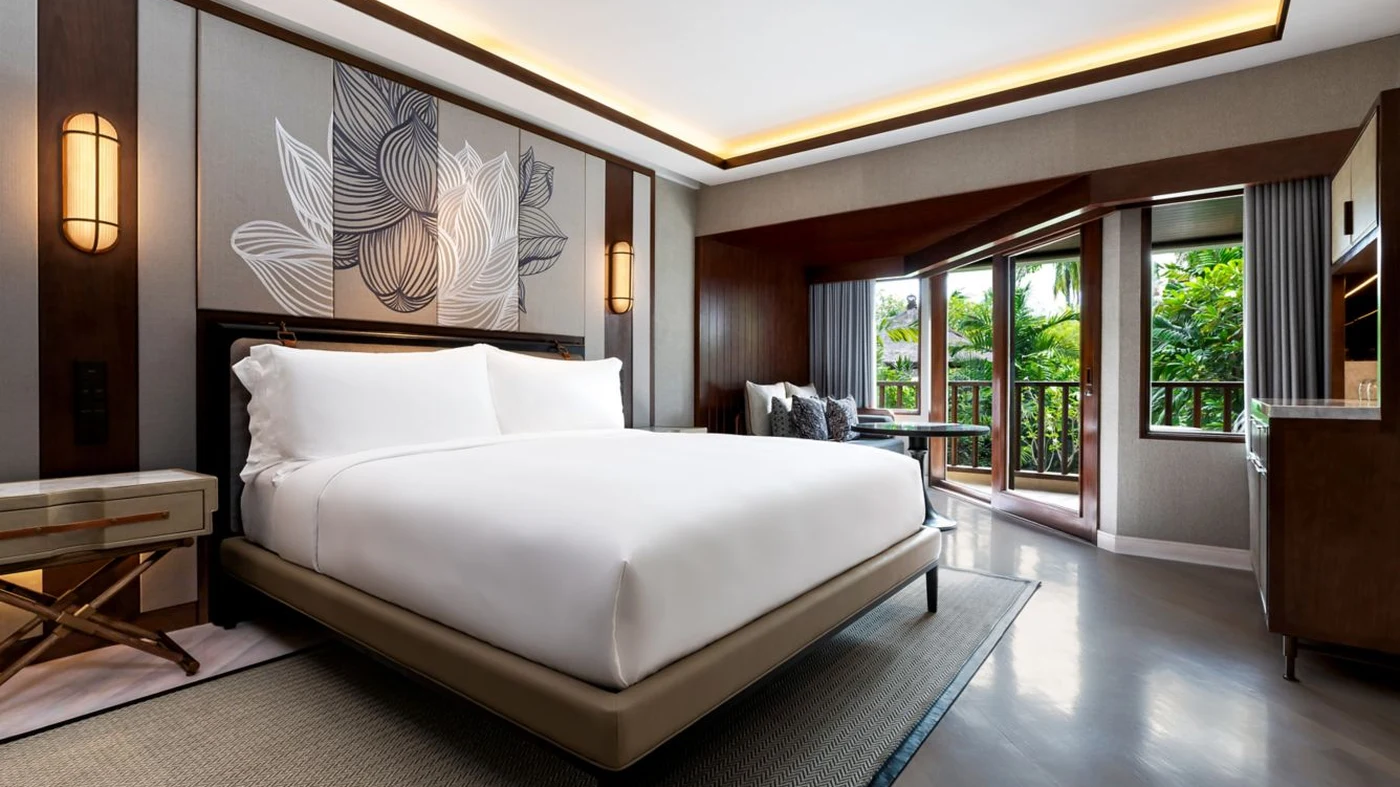
For a family, the villas make obvious sense. For a couple, I'd take a Lagoon Access room and spend the difference on dinner, because the honest truth is that we barely used the room. We were always at a pool, on the peninsula, or at Kulkul. A hotel doesn't need to win the room if it's already won the rest of the day.
Rates start around $250 a night, all-in with breakfast, a resort credit, an upgrade, early check-in and late checkout. At that number there is very little to argue with, and I'd call it the best value in Nusa Dua at this level by a clear margin.
Restaurants rebuilt, not redecorated
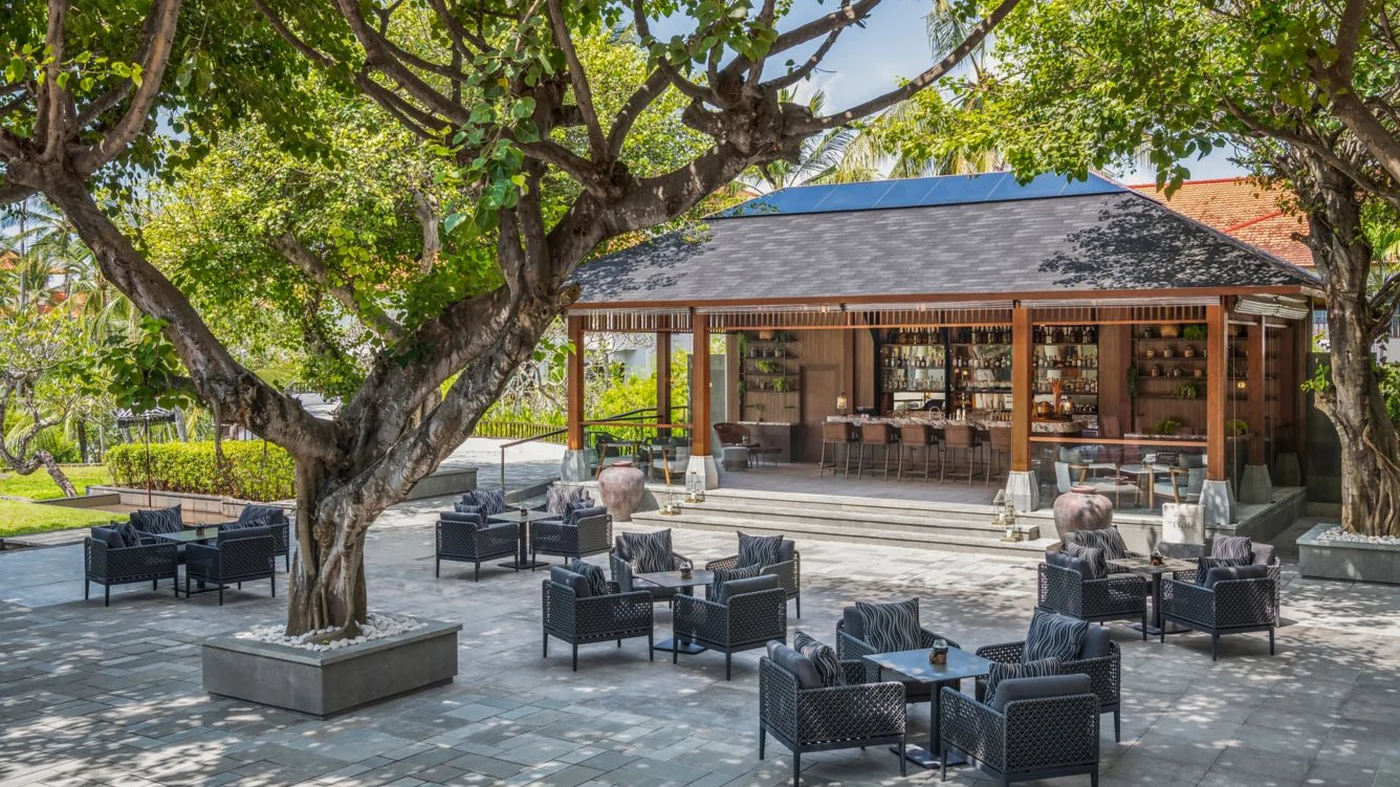
Most of our meals happened at Arwana, the beachfront restaurant that closed out the renovation, and in all its simplicity it was outstanding: good ingredients, precise cooking, nothing reaching for effect. My wife worked her way through the sushi. I kept returning to the lobster spaghetti and the thermidor. It runs pricey and it's worth every bit of it.
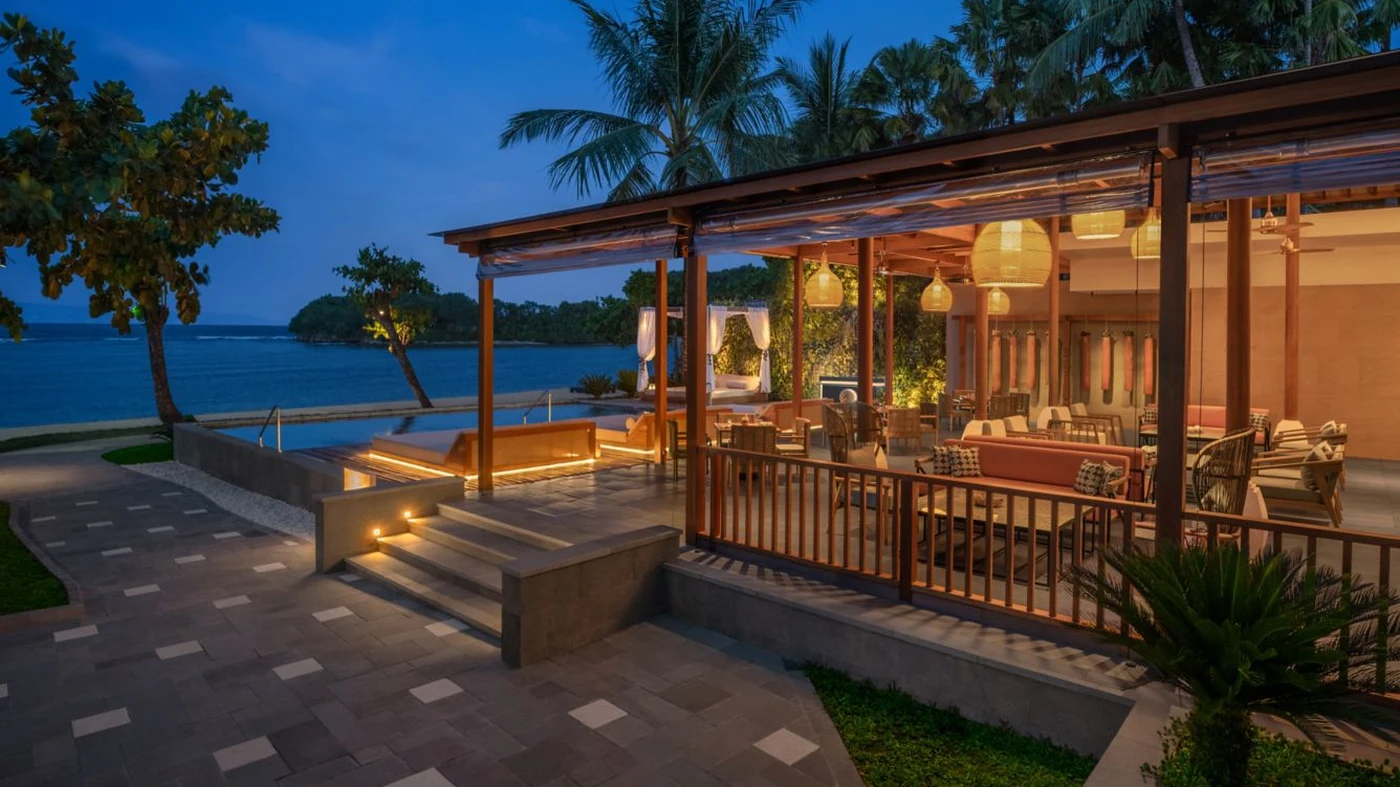
Kulkul Beach House was the other constant, and it might be the best beach bar I've come across in Bali. Real energy to the place, relaxed rather than loud, excellent food and drinks, and staff who matched the mood exactly. We planned to go once and ended up there most days.
Breakfast was excellent every single morning, and the reason is structural rather than culinary. Banyubiru was rebuilt around a show kitchen and warung-style stalls, so it reads as a small market with everything cooked to order rather than a buffet sitting under heat lamps. That distinction is the whole reason it works.
Two honest flags
The 24-hour butler service gets marketed as a signature feature and it doesn't hold up. At The St. Regis a butler genuinely changes the shape of a stay. Here the resort isn't operating at the tier where that promise gets delivered, and I don't understand why they lean on it as hard as they do. It's the one part of The Laguna that oversells itself, in a hotel where everything else undersells.
The other is practical: sunbeds go fast, and we didn't always find one where we wanted it. If a particular spot by a particular pool matters to you, build it into your morning.
Who this is for
For most people going to Nusa Dua, this is simply the right answer, and I don't say that about many hotels. If you want classic Bali, the version that has quietly disappeared from most of this coast, this is where it still is. Families especially: the density that makes the resort feel intimate also means a child can be out of sight for thirty seconds without being lost across a hectare of lawn, and between the lagoons, the crabs and the birds there is more to do here without leaving than at any comparable hotel in the area.
The alternatives only come into play if you want something specific that The Laguna deliberately doesn't chase. If you want the hotel itself to be the event, the thing you flew here for, The Apurva does spectacle a few minutes up the road with far more conviction. If you want polish and privacy above all, Raffles is the better fit. And if the butler line is what's selling you, book the St. Regis and don't look back.
My friend never did get the Bali he'd been dreaming about, and I've thought about that more than once while walking these gardens. Of all the hotels I've stayed at on this stretch of coast, the days here went the fastest, and nothing was rushing them along. Nothing at The Laguna is trying to be the whole point of your trip. It just quietly makes sure you never have to go looking for one.
The Laguna, a Luxury Collection Resort is available through The Banjar Collective.
GET IN TOUCH TO PLAN A STAY →