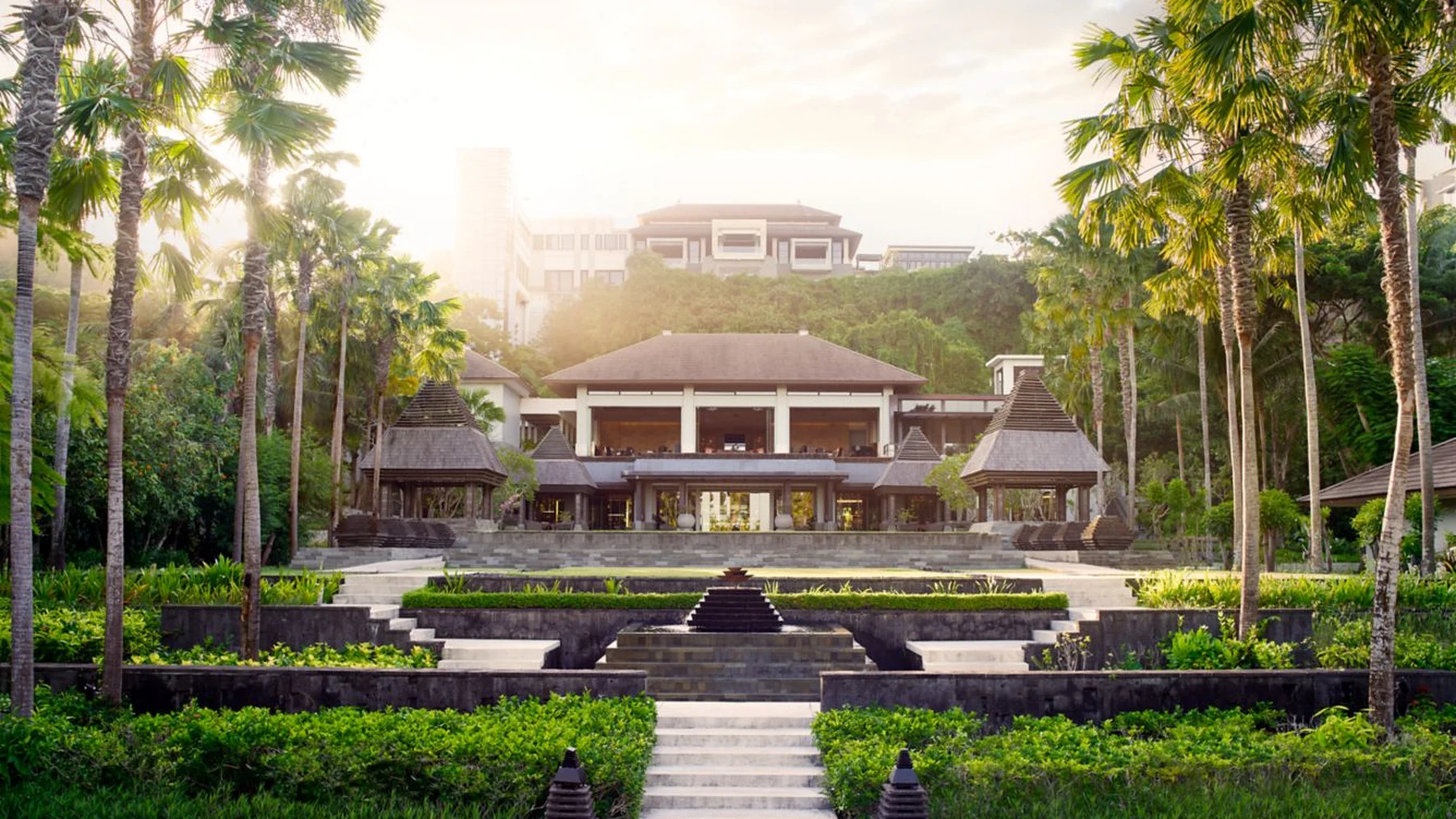
Check-in happens up on the clifftop, the way it does at Mandapa or at Apurva further along this coast: a lobby that hands you the whole property in one view before you've sat down. Then a glass elevator carries you down through the rock face to the lower level, one of the better arrival sequences on the island. The doors open, and what's in front of you isn't the wall of blue water a resort this size would normally lead with. It's a garden. Wide, green, almost park-like, dense and properly mature, footpaths that wind instead of run, koi ponds tucked into corners that didn't need to exist and clearly do because somebody wanted them there.
It costs the place a little holiday feeling, that choice. You don't step out of the lift and immediately want to swim. But it's the most considered piece of landscape design I've walked through at a resort this scale, better than the buildings standing in it.
I remember being genuinely pleased that first afternoon, and also quietly waiting for something else to arrive. The feeling I usually get somewhere this good. It didn't come that afternoon and it never really did.
For a long time I assumed that was on me. I've spent fifteen years travelling professionally, and I've stayed in most of the hotels people build bucket lists around, which is a useful frame of reference right up to the moment you start wondering whether it's a frame at all or just armour. Have I gone blasé? Old? Am I simply a snob who needs a hotel to be difficult before it counts? Those weren't rhetorical questions. I sat with them for a while, because people whose judgement I trust had told me how much they loved this place, and second-guessing myself seemed far more likely than the hotel being the problem.
It took me months after we left to accept that the flat feeling wasn't me being difficult.
Usually, when every individual part of a hotel is this good, the whole is too. That's roughly how the arithmetic of a hotel is supposed to work. This is the one property on the island that has broken it for me, more than once, and it took me a full stay and a long time afterwards to work out why.
A building drawn for a different name
Part of the answer is history. This hotel was in development as a Regent before the brand was reassigned, fairly late, ahead of its opening in February 2014. WATG did the architecture, Burega Farnell the interiors, and the bones were largely locked in by the time the name on the door changed. A building carries a kind of promise about the sort of stay you're about to have, and this one was written for one brand and delivered under another.
The other part is what it was actually built to do. This is one of the busiest wedding and conference venues on this stretch of coast: two chapels, a ballroom, function rooms sized for a steady churn of events rather than a handful of overnight guests. That explains almost everything about how it feels to walk through. Wide transitional spaces, grand entrances, a layout designed to move large numbers of strangers efficiently and impressively from one point to the next. It's a hugely capable machine for hosting other people's biggest days. It just isn't built around the smaller, quieter question of how one couple on an ordinary Tuesday feels wandering through it.
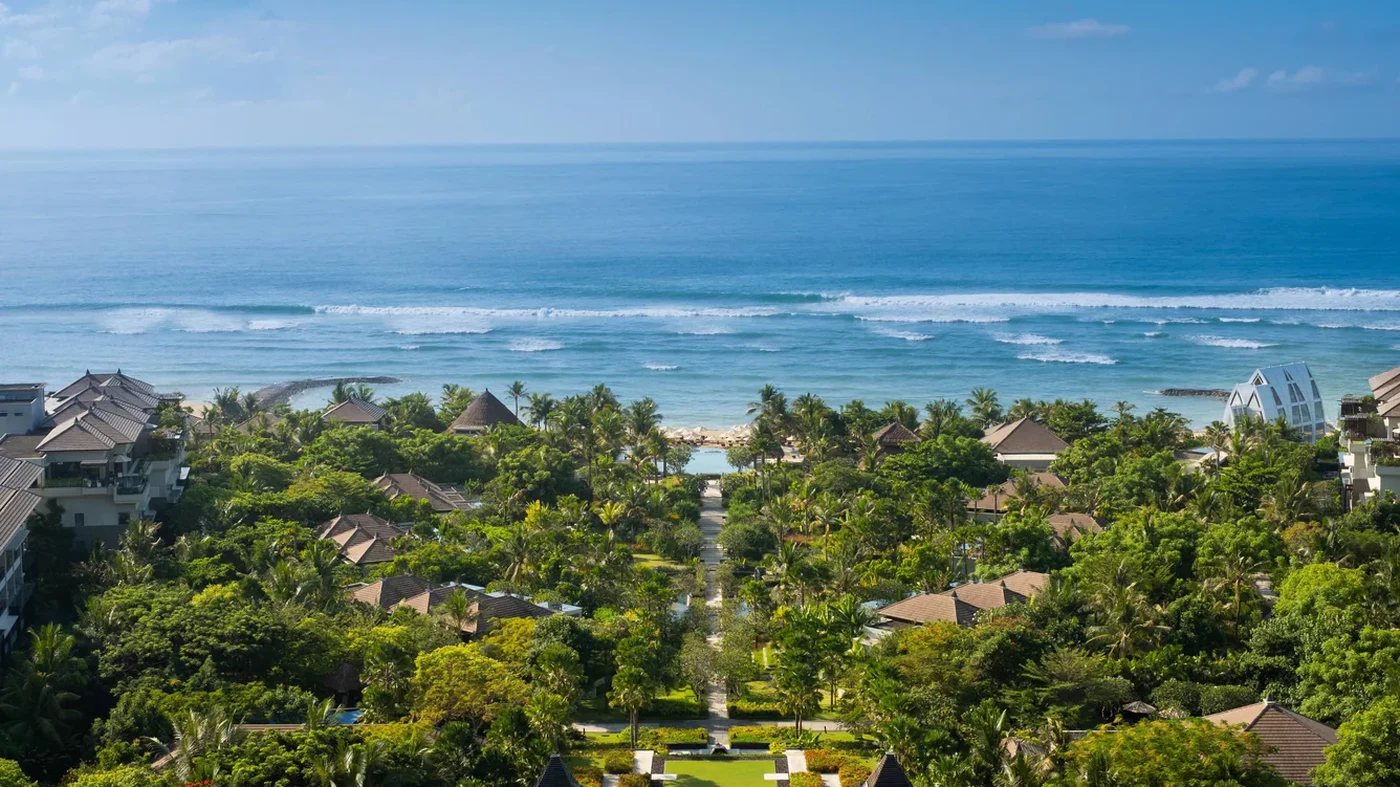
I've wondered since whether a younger traveller who's never stayed at the island's older guard reads a building like this completely differently. Tanah Gajah, Amankila and The Legian all ask you to sit with a kind of unpolished warmth that takes a day or two to appreciate. The Ritz-Carlton asks nothing of you at all. It's immediate, symmetrical, built for a photograph before it's built for a feeling. Almost every corner of it photographs beautifully. Whether that's the same thing as a hotel that feels good to be inside is the question this whole piece is really about.
The rooms are the easy part
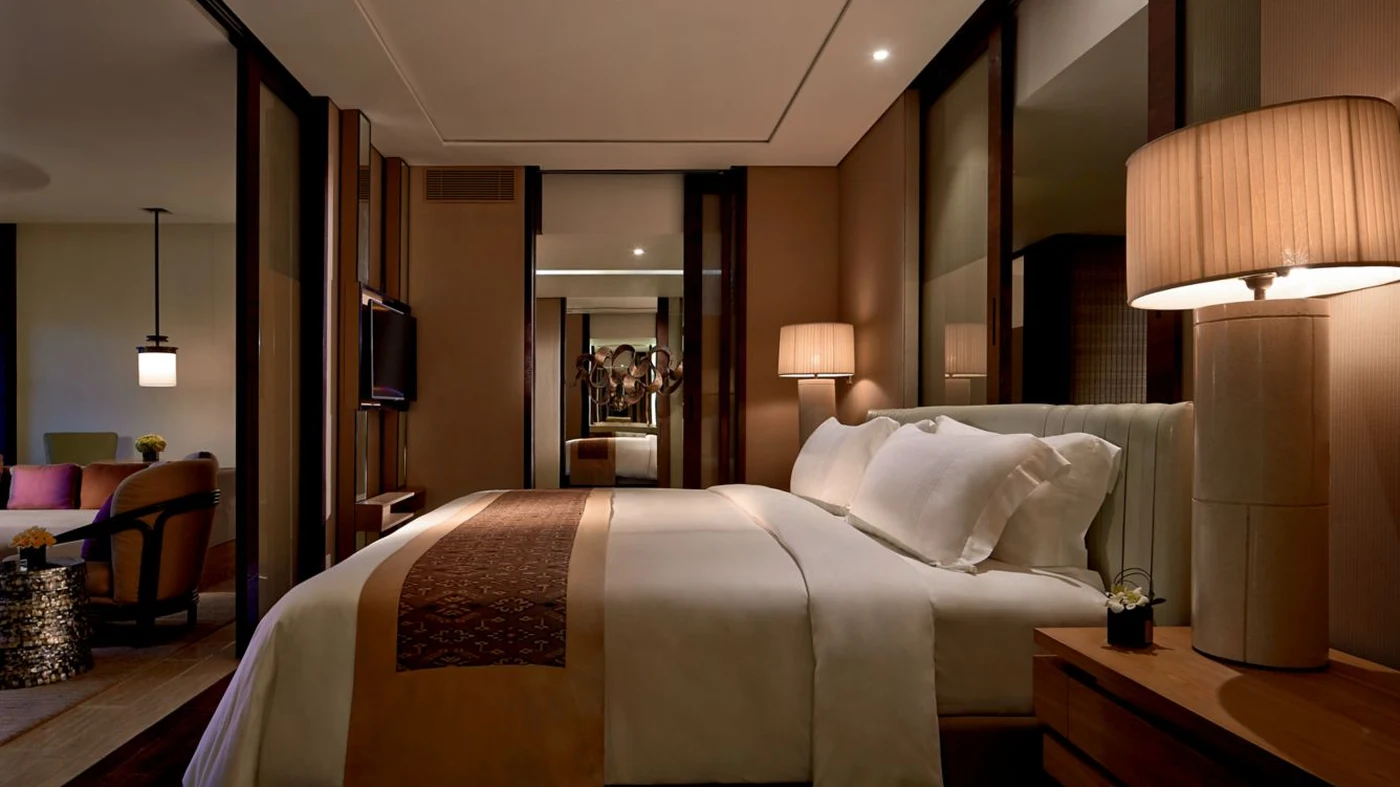
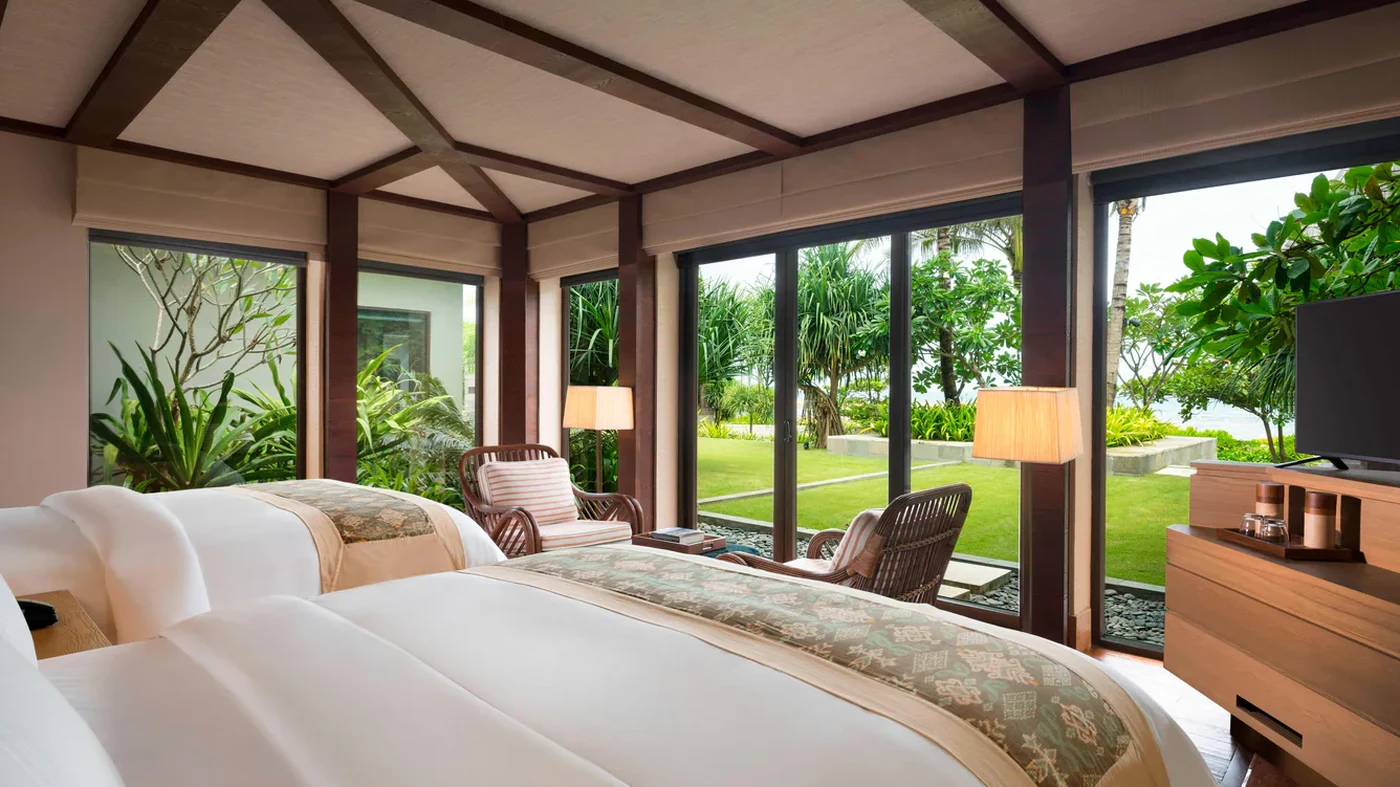
We stayed in a Sawangan Junior Suite with an ocean view, and on its own terms it's an excellent room. The bed is one I remember specifically. The bathroom is enormous in the real sense, not just generous by hotel standards. Entry suites here start around 100 square metres, and at roughly €325 a night that's a serious amount of space and finish for the money.
One thing I'd correct before you book: the ocean-view categories sit far enough back from the water that the view barely registers. Book this room for the space, not the outlook.
Above that the categories scale up quickly. The two-bedroom Sky Villas run to around 240 square metres with a pool of their own, and the largest Oceanfront Villas stretch past 600 square metres, closer to a small private estate than a hotel room, with the floating breakfast across the pool as the signature flourish. That's a wide spread, from a well-priced entry suite to something built for a family group or a genuine occasion, and the right category here depends entirely on the kind of trip you're planning rather than on reaching for the highest name on the list.
Rendang as a benchmark
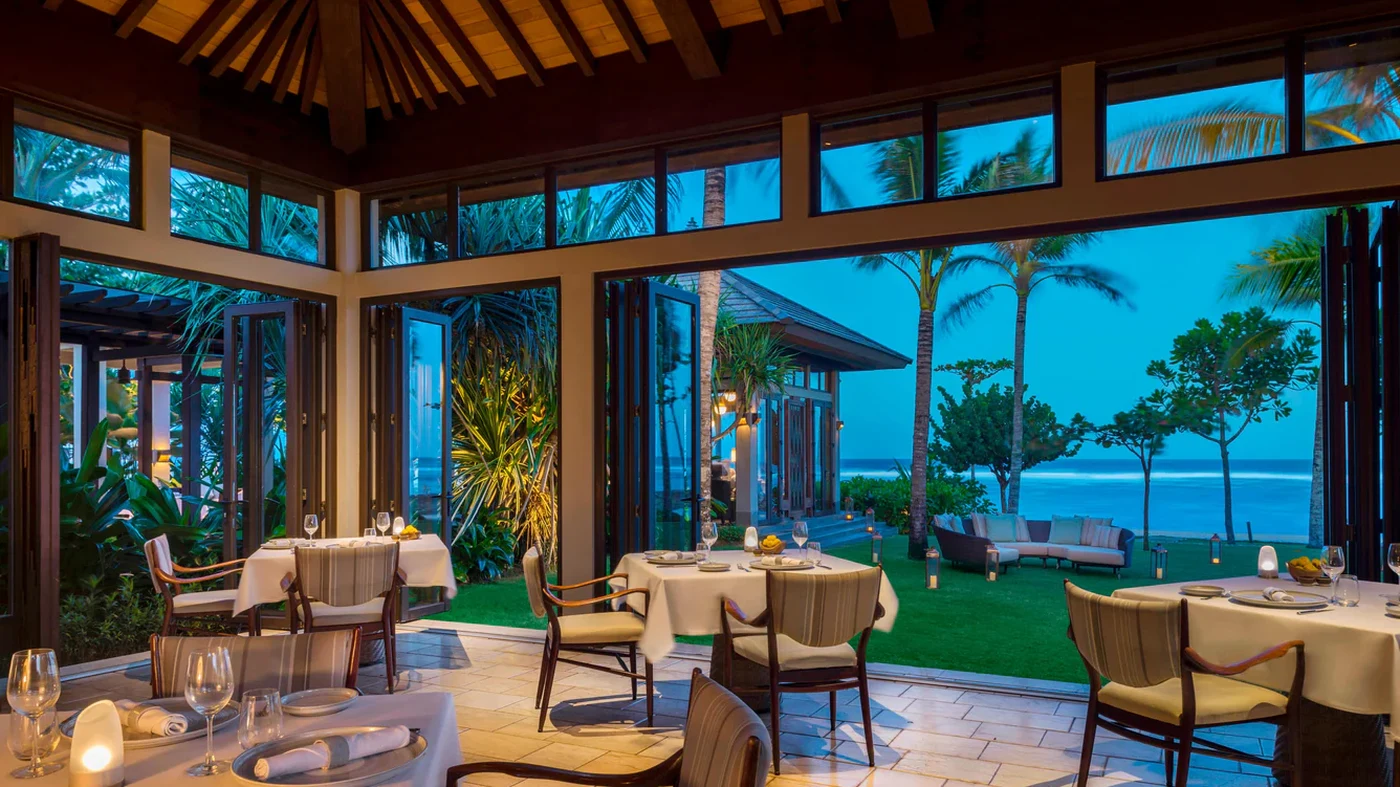
The kitchen is where this hotel most clearly earns its reputation. Bejana, the Indonesian restaurant built into the cliff, serves a rendang I still measure every other version against, easily the best I've had anywhere, alongside a properly good babi guling and a sambal cart worth flagging down on its own.
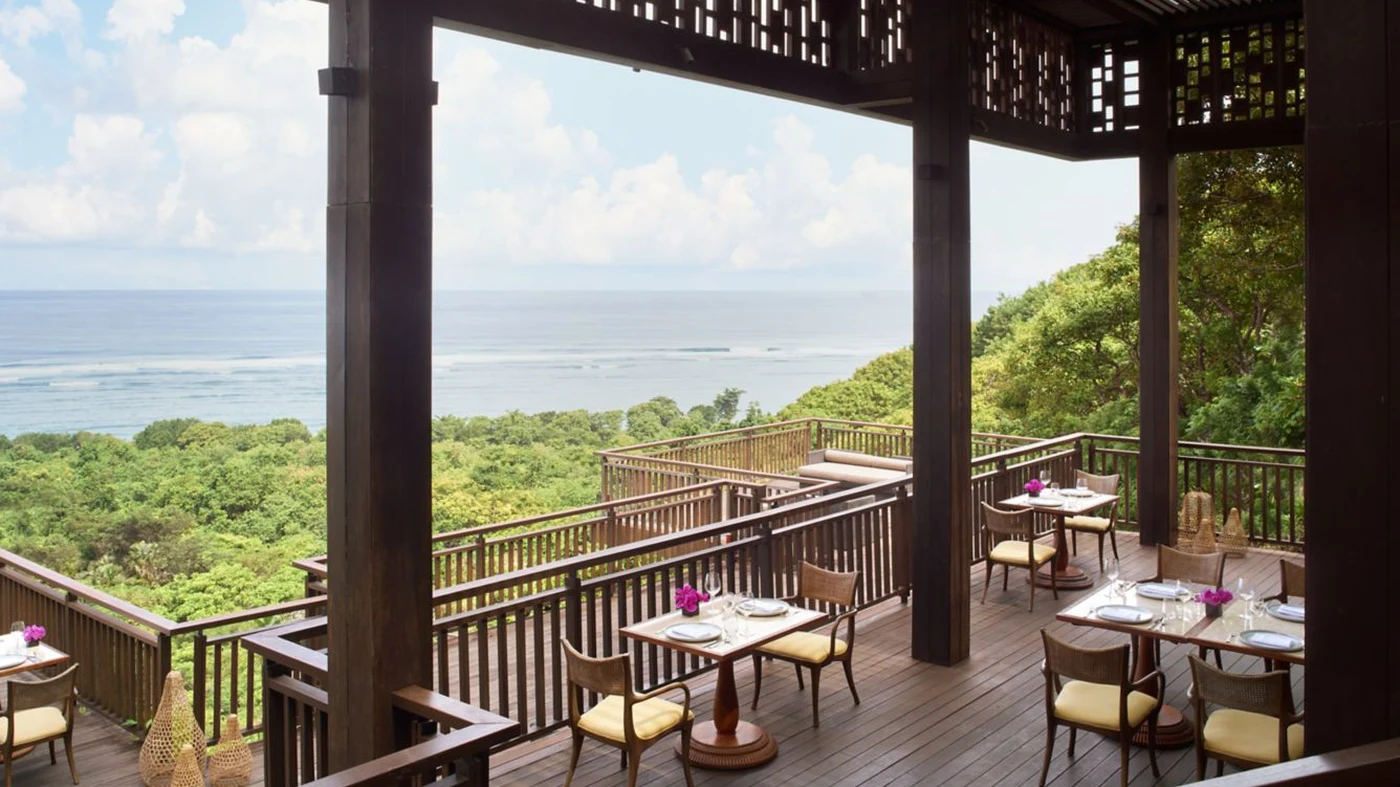
It shouldn't be surprising to find Indonesian cooking taken this seriously on the island where it comes from, and yet it is. Between kitchens that don't push themselves and menus quietly softened for a Western palate, good, unapologetically local food is oddly hard to find at this scale here. Bejana is one of the few five-star tables in Bali where the rendang isn't the safest thing on the menu.
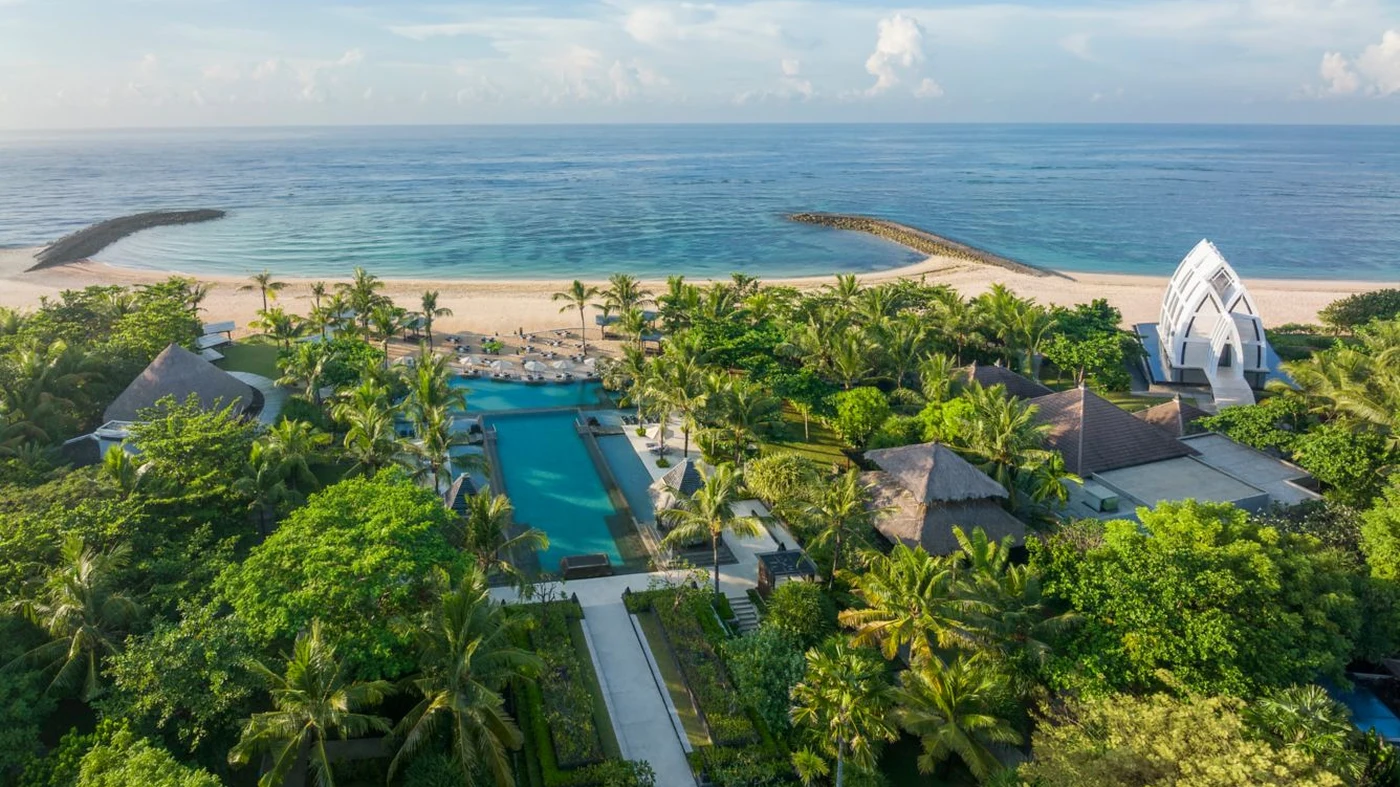
Down on the beach, the old grill is now the Missoni Café, and the beach itself is better than most hotels on this stretch manage. A line of breakers offshore keeps the water closer to a lake than an ocean. I noticed staff out tidying the sand more than once during our stay, not a token pass but real, repeated work. Small thing, but it fits the pattern that runs through the entire resort: whatever else is true here, nobody is coasting.
Six hellos on the way to the pool
I don't think I've stayed anywhere on this island where the staff work this hard. One short walk from our room to the pool, I counted it once out of boredom, drew warm hellos from six different people: two gardeners, a housekeeper, someone from the spa I'd never spoken to, two more I never identified. By the fourth I was smiling back on autopilot, faintly embarrassed, the way you do when a stranger holds a door for you three times in the same building. Order a buggy and one arrives before you've finished the sentence.
What I didn't get, across the whole stay, was a conversation. The effort read as trained rather than spontaneous, service polished to a level that leaves very little room for anyone's personality to come through it. At Jimbaran Puri or Amankila I've ended up talking to staff about their villages and their families. Here I got warmth delivered at volume, and almost nothing that felt like it came from one particular person.
And then the same team produced two of the most thoughtful gestures I've had at any hotel anywhere. An authentic beach bag and two Balinese hats left in the room, ours to keep rather than borrow. A real leather bookmark tucked into a book I'd left face-down on the nightstand. My wife carried that bag for the rest of the trip. Whatever the drilling does to spontaneity in the moment, it clearly hasn't drilled the generosity out of the people doing it.
A monument you visit, not a home you're welcomed into
Put all of it together and the shape of the ambivalence gets clearer. The grounds are enormous, enough that we never settled on a favourite corner the way I usually do somewhere this size. The liveliest stretch is down by the beach, where the pool and the Missoni Café let the place relax a little. The garden, walked slowly, is where the resort comes closest to the warmth its own design language keeps promising. It's the buildings around it that never resolve into the same feeling, the concrete base at the foot of the cliff in particular, almost fortress-like against all that open water.
One part of this resort was designed by someone who understood tri hita karana. The other part was designed for a different brand's photograph, and for guests counted in hundreds rather than in couples.
That's the whole equation. Excellent rooms. A kitchen that takes the island's own food seriously. A garden that gets the warmth exactly right. A staff working harder than almost anywhere else. And somehow, added together, a hotel that impresses far more often than it embraces. I don't think that's a failure in any single part. I think it's what happens when a building's bones were drawn for one brand's promise and one kind of guest, and a different brand and a different kind of stay moved in.
Who this is actually for
This is where I'd stop asking whether the hotel is good and start asking who it's good for, because on that question it does much better.
If you're getting married here, or bringing a group, or celebrating something that involves more than two people, this hotel is close to unbeatable on the island. Everything I've described as a weakness for a couple on a quiet week, the scale, the processional spaces, the machine-like competence, becomes an outright strength the moment the occasion is big enough to fill it.
If you're travelling as a family and want serious square metres for the money, the villa categories here are among the best value in this bracket in Bali, and the beach is genuinely good rather than merely present.
If what you want is a hotel that feels like somewhere rather than something, I'd point you inland or up the coast. The St. Regis does grandeur on this side of the island with more conviction about it. Amankila and The Legian will give you the warmth this building can't quite produce, at the cost of the space and the newness.
I never did get the feeling I kept waiting for in that garden. What I got instead was a straw beach bag my wife wouldn't put down and a leather bookmark nobody had to think to leave. I'm not sure that adds up to loving a hotel. It's close enough that, given the right occasion, an anniversary, say, I'd go back and let it try again.
The Ritz-Carlton, Bali is available through The Banjar Collective.
GET IN TOUCH TO PLAN A STAY →