On our last afternoon at Amarterra, the staff taught us to make jamu. We ground turmeric, ginger and tamarind and stirred them into small glasses of the tonic Indonesians have been drinking for centuries. It’s meant to taste a little bitter, because the bitter part is what does you good. I’ve thought about that class a lot since, because it describes this review rather well. Amarterra has more than fifteen hundred reviews online, and almost all of them read like love letters. Mine is one too. It just has a bitter note in it, and I’d ask you to drink that part as well.
Arriving
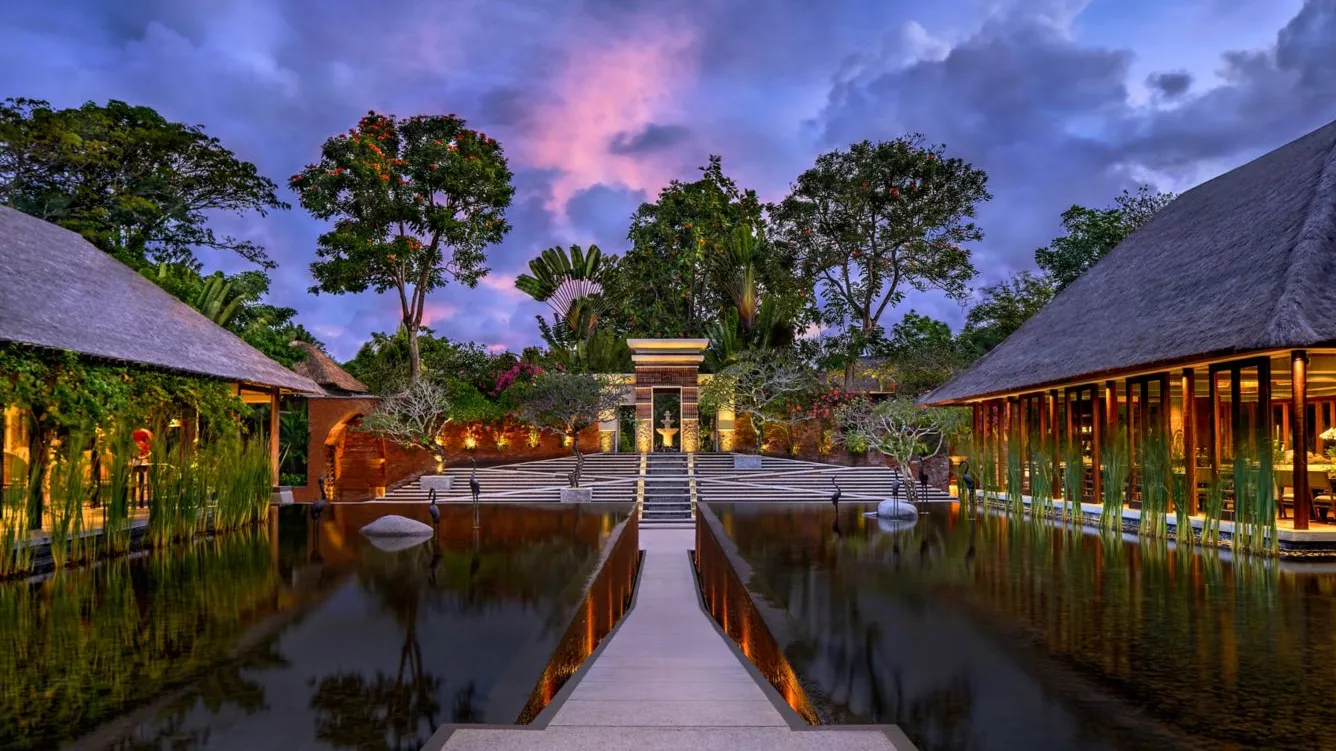
The name is a small piece of poetry: amarta means water and terra means earth. The resort is built around both, with ponds, a bamboo garden and water that runs, falls and reflects wherever you look. The architecture borrows from the Majapahit kingdom of Java, whose priests and artists fled to Bali when it collapsed five centuries ago and brought much of what you now think of as Balinese with them. So it’s fitting that you arrive through a red-brick gate of the kind you see in front of temples all over the island.
What happens next is something I’ve rarely seen done this well on so little land. The path runs between two long reflecting pools, with water sheeting down the walls on either side and bronze herons standing in the shallows, and somewhere along it the noise of Nusa Dua simply switches off. At the end, someone blesses you with holy water and hands you a length of batik. It’s theatrical, and it works. You haven’t seen your room yet and your shoulders have already dropped an inch.
The walk
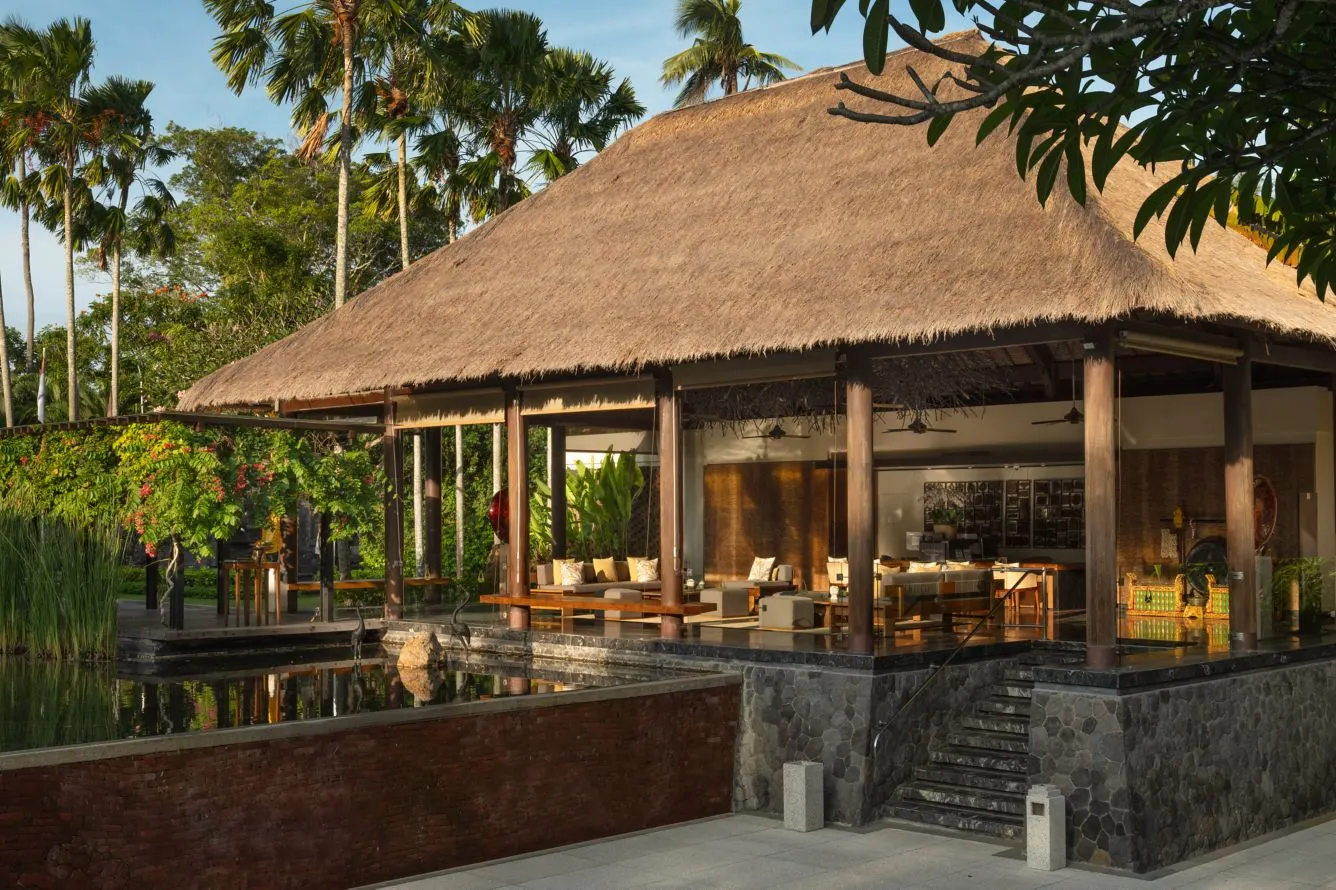
Amarterra has forty-two villas on a plot that is small by the standards of this enclave, where the big resorts down the road have five times the land. And yet the walk from the lobby to your villa turned out to be one of the pleasures of the stay. I can’t say that about most of its neighbours. I’ve stayed at hotels in Nusa Dua where the walk to my room took long enough to reconsider several life choices. Here it was over too soon.
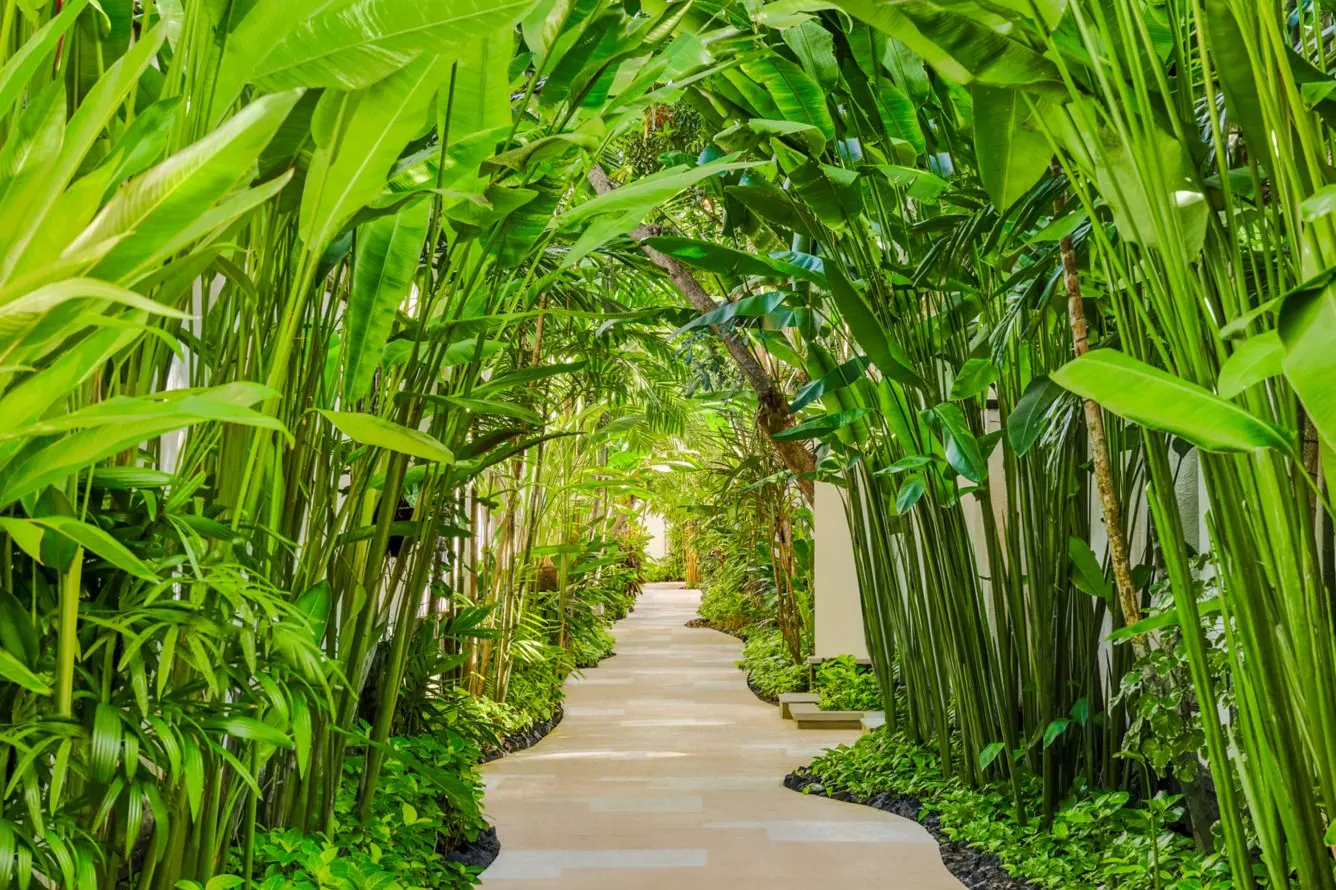
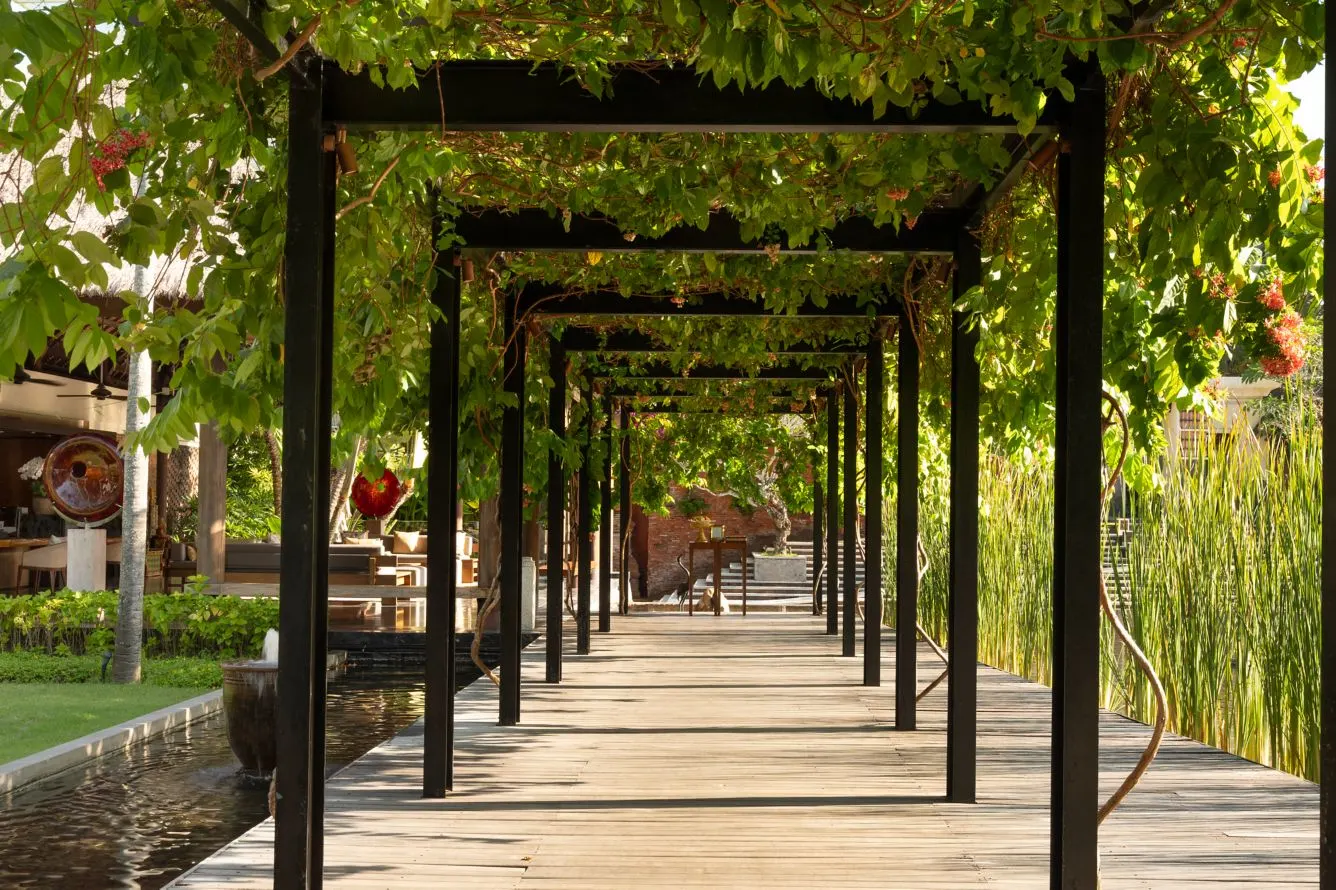
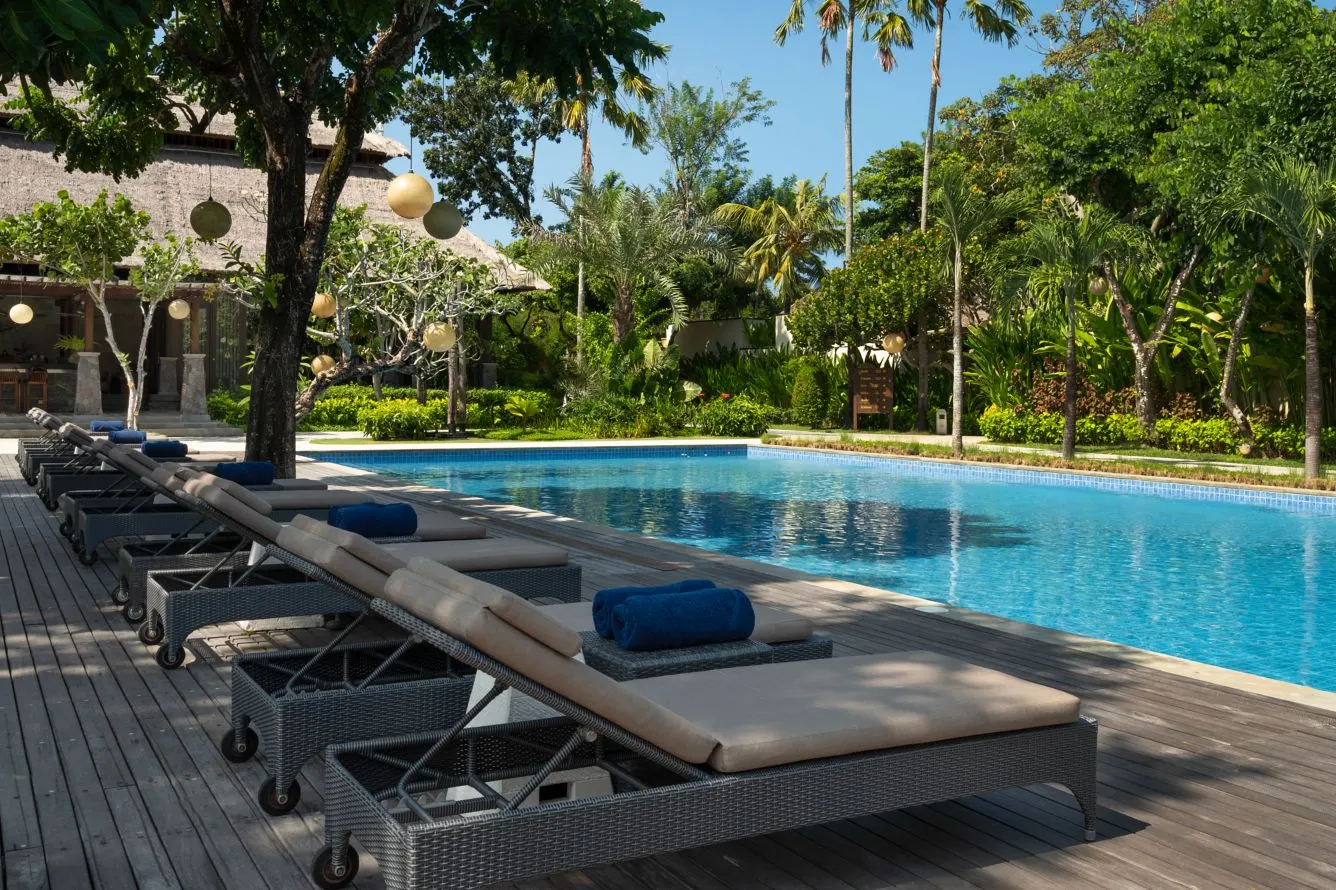
The trick is that the path never shows you everything at once. It runs under a pergola heavy with flowering vines, turns into a corridor of bamboo, crosses a garden and opens onto the main pool, shaded by old trees hung with paper lanterns. Every few steps the view changes, so the resort feels like a village you’re crossing rather than a site you’re walking through. After dark the effect doubles. The paths and staircases are lit low, the trees are lit from below, and you find yourself taking the long way to dinner on purpose.
A village built to a business plan
To understand Amarterra, it helps to know what Nusa Dua is. In the 1970s the Indonesian government drew it on a map, with a master plan funded by the World Bank, as a gated enclave where tourists could be kept away from Balinese villages and the island’s culture protected from what tourism had done elsewhere. The first hotel opened in 1983. Today eight of the ten largest hotels in Bali stand here, and the Grand Hyatt opened in 1991 with more than six hundred rooms.
So there’s an irony in walking through Amarterra’s gate. Thirty years after an enclave was built to keep visitors out of Balinese villages, someone built a Balinese village inside it, to sell them what the enclave had kept from them. Among neighbours with hundreds of rooms, it’s the small, intimate, local-feeling alternative, and there are almost no others. The only other true hideaway here is Amanusa, which these days is a curious product of its own.
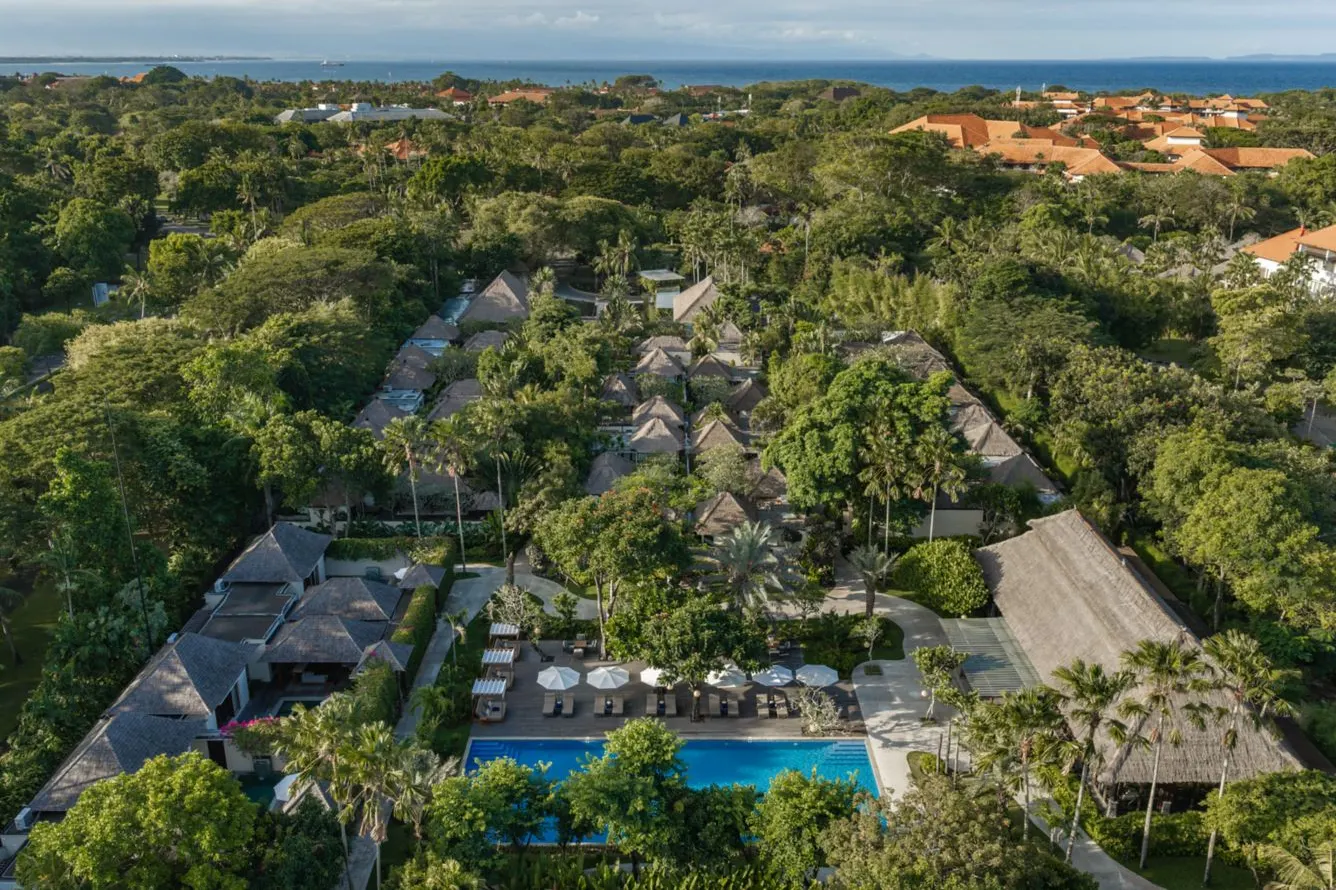
I can’t shake the feeling that Amarterra began as a gap in a market rather than a love affair with a place, and that the Majapahit design is a concept chosen to stand out from the big resorts next door. What I’m sure of is this: the only thing at Amarterra that didn’t come from a business plan is the people. The village was designed. The family wasn’t.
The villa
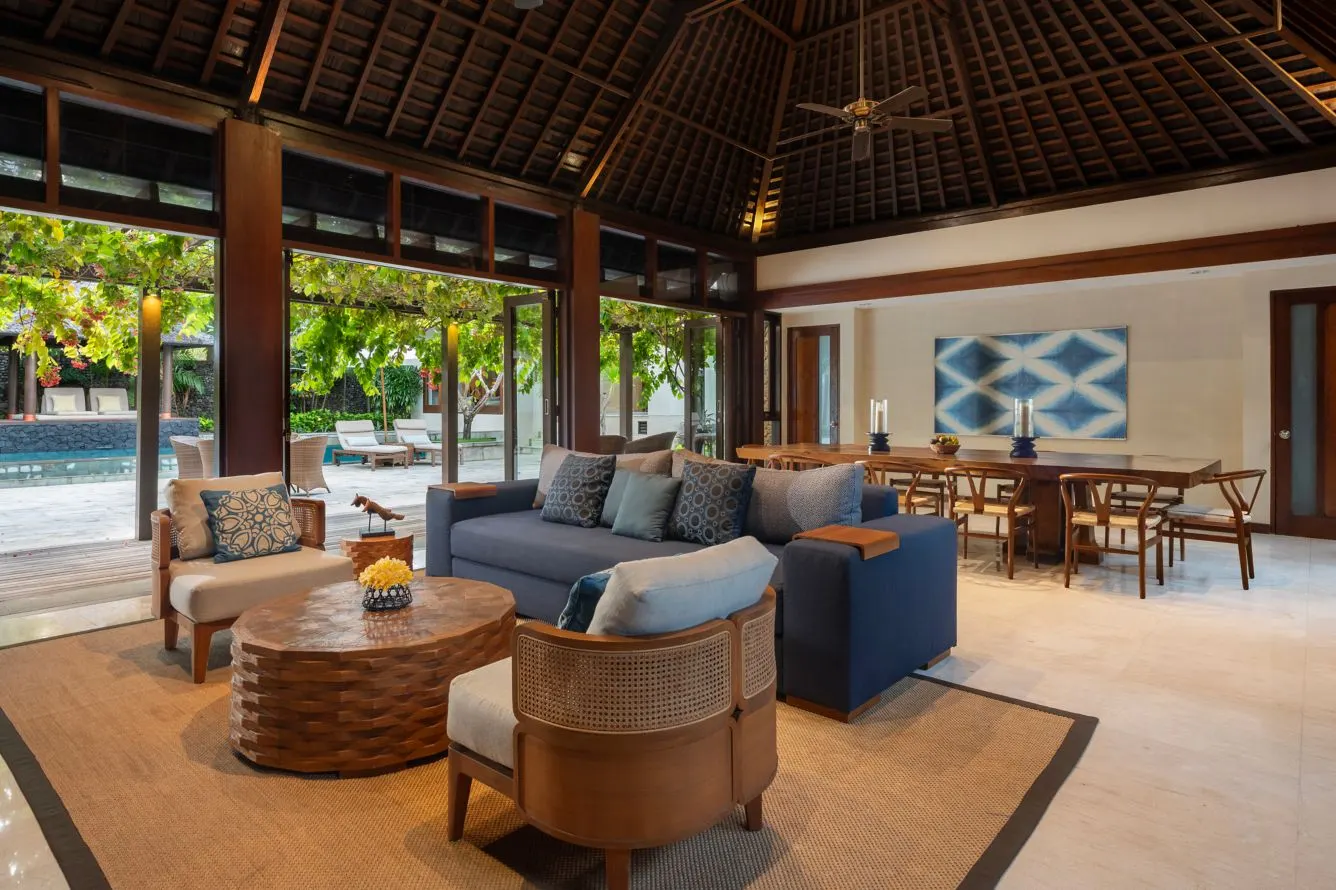
Ours was a one-bedroom villa of around two hundred square metres behind its own high wall. It had a pool long enough to swim in, a pavilion beside it for doing nothing in the shade, and a shower both inside and out, which in Bali is less a feature than a moral obligation.
But the thing I loved most was the living room. It opens fully onto the garden, so it’s half house and half terrace, and I’ve hardly seen it done that way anywhere else on the island. I spent more time there than in the bedroom, reading, dozing and watching the light move across the water. I slept well, and it was one of the easiest places I’ve ever been to do nothing at all.
The days
Here’s the odd thing. We had our own beautiful pool, and we still spent most afternoons at the main one, because that’s where the staff were.
I wouldn’t describe them as trained for a luxury hotel, at least not the way the cast at Mandapa is trained. Nobody here follows a script. They’re more like a large and very kind family that has decided, for reasons of its own, to look after you. As far as I could tell, the word “no” doesn’t exist on the property, and they genuinely want to know how your day went. People rarely come home from a hotel remembering the names of the staff. From Amarterra, they come home with a list.
There’s something free to do every day, from morning yoga and aqua aerobics to beach walks and that jamu class, and there are bicycles if you’d rather go off on your own. None of it is compulsory, and all of it is worth doing.
The beach that isn't there
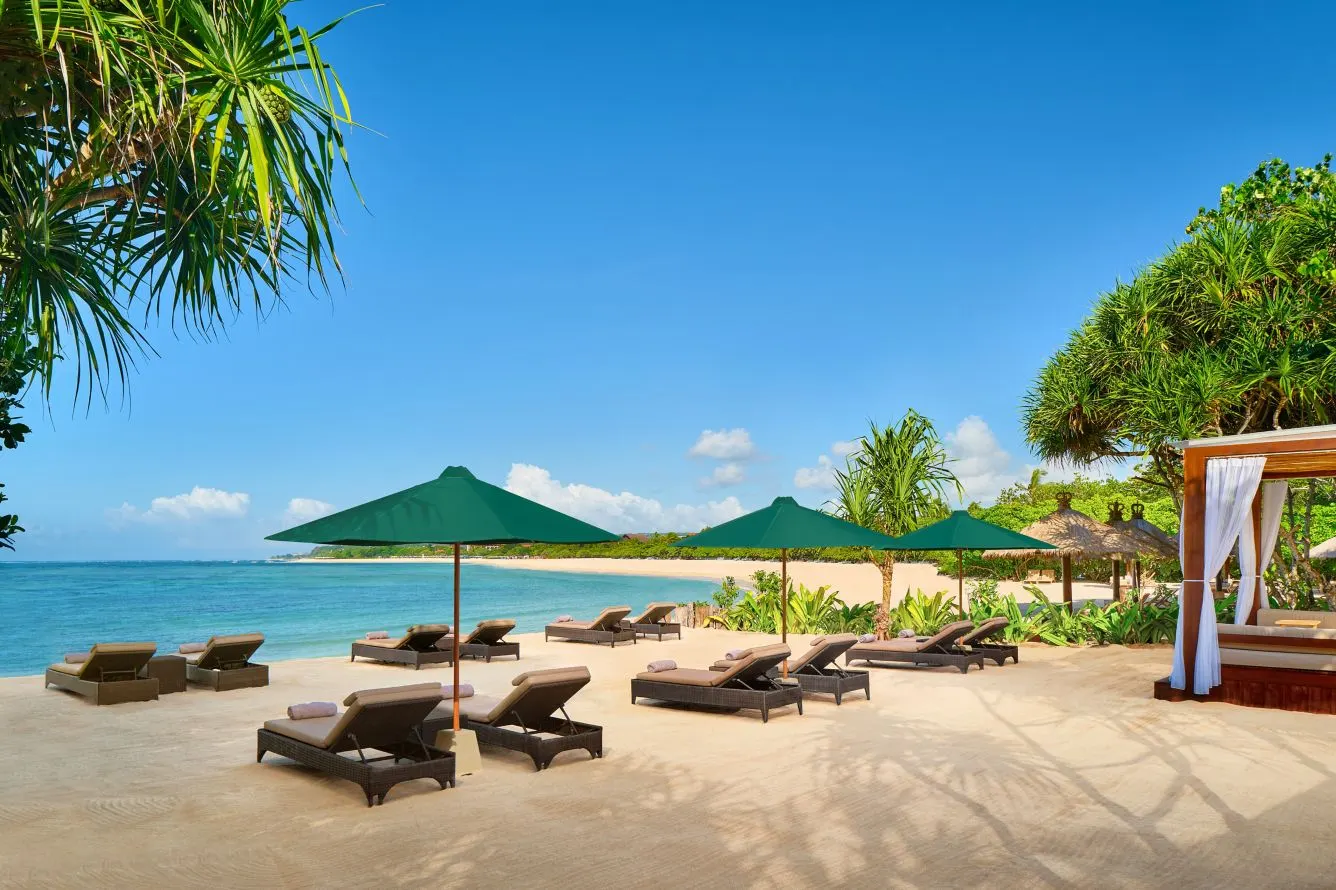
A resort in Nusa Dua without a beach is a bit like a ski chalet without snow, and it took me a day to forgive it. The odd part is that at most hotels here I hardly use the beach at all. At Amarterra I missed it. Not having the sea in view made the place feel smaller and less free, and I hadn’t realised how much of the sense of space in Nusa Dua comes from the horizon until it wasn’t there.
At Kayumanis Jimbaran the same problem barely bothered me, because the sea was a lovely five-minute walk away. Here it’s about ten minutes on foot, or a short ride in a comfortable car. And fair is fair: they’ve solved it about as well as it can be solved. Amarterra’s own stretch of sand has sunbeds, towels and cold water waiting, and it’s a genuinely good place to spend a morning. The same free shuttle will take you anywhere in Nusa Dua, whenever you ask rather than to a timetable. You give up the sea at your door. You don’t give up the sea.
The food
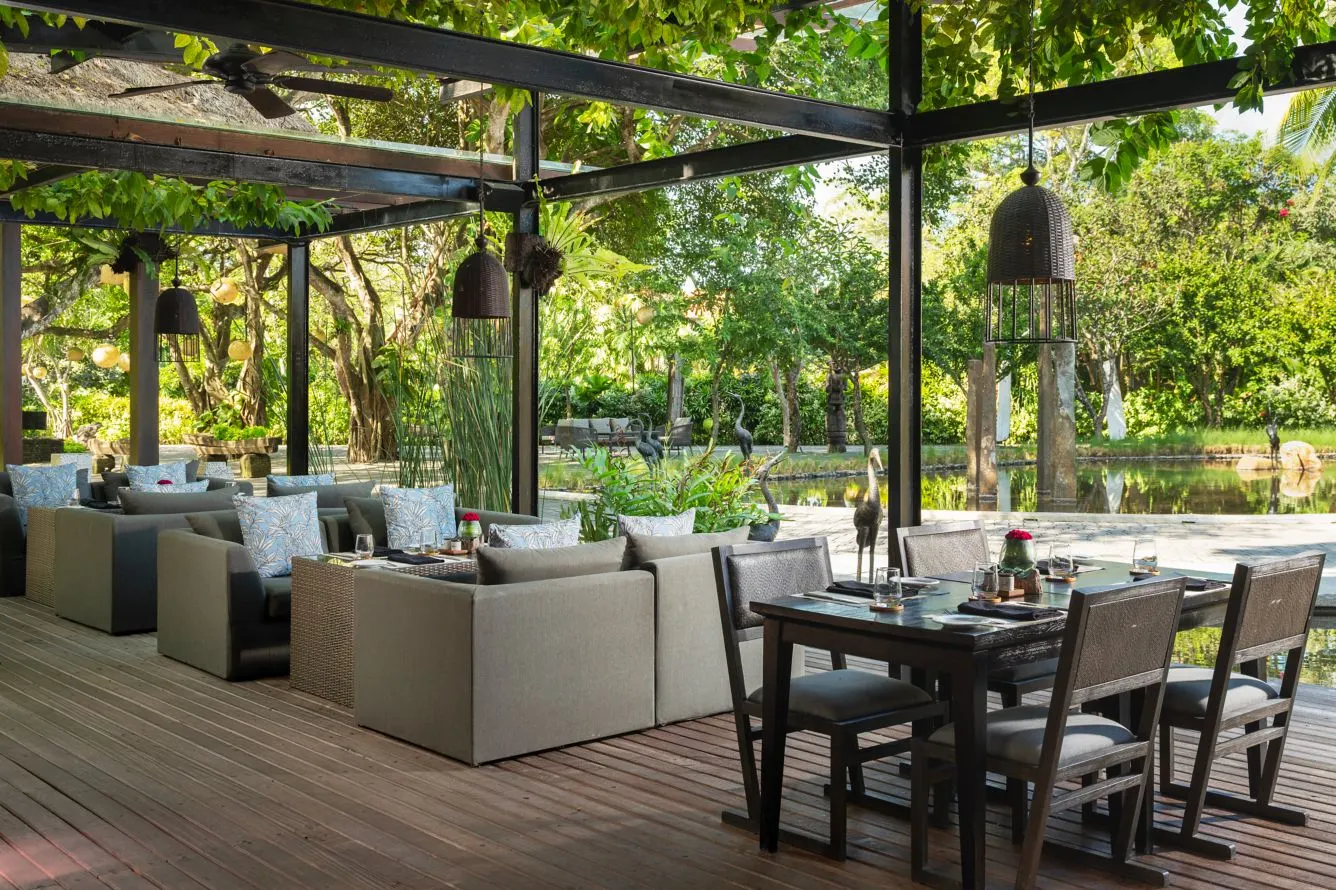
Dinner is where Amarterra’s ambition and its kitchen part ways. On paper there’s plenty going on. Maja, the one restaurant, sits at the front of the resort, half indoors and half out, with a menu that travels from Indonesian classics through pan-Asian dishes to pizza and burgers. Some evenings it becomes a Balinese night or a satay night beside the reflecting pools. There’s a barbecue on the beach, and if you’re celebrating, they’ll set a single table under a tree or cook you a five-course tasting menu.
The trouble is that the cooking behind all those settings plays it safe. What reached our plates was predictable hotel food, competent and pleasant, from a menu that has clearly sat through a lot of meetings about what guests from twenty countries might want. Breakfast is ordered from a menu rather than queued for at a buffet, and they’ll bring it to your villa if you’d rather not get dressed, which on a slow morning here is a very reasonable position. For dinner with more character, the shuttle will drop you at the Bali Collection a few minutes away. After dark, the walk back through the lit garden is half the reason to go out.
The bill
Every hotel gets two reviews from its guests. The first is written on the last night, still warm from the pool and the goodbyes. The second arrives with the credit card statement. Amarterra wins the first almost every time. My job is to write the second.
When we checked the hotels’ own websites for two nights in mid-November, a one-bedroom villa at Amarterra came to $414 a night for two, with breakfast and taxes. For that you get your own villa, a beautifully made resort and staff you’ll miss. But in Nusa Dua, $414 buys a great deal. A room at The Laguna, right on the beach and the easiest resort in Bali to get around, was $333. A junior suite at the Ritz-Carlton was $365. The Grand Hyatt, on the sand and with a kids’ club, was $225, and the Conrad just $173. At Amarterra you pay more than any of them and trade the beach for a private pool. For some people that’s exactly the right trade. It just isn’t a bargain, and almost none of those fifteen hundred reviews will tell you so.
Families pay more again. For two adults with children of four and one, the website offered a two-bedroom villa at $1,124 a night, around 2.7 times the price for two. What 44 hotels charge a family →
When I'd book it
If you’re coming to Bali for the first time, on honeymoon, or with three generations who want their own pool and a team that treats them like family, Amarterra will very likely win you over. Nothing about it will disappoint you, because it scores well on almost everything that can be scored.
I’d recommend it without hesitation at around $250 a night, which is what I think it’s worth. So book it when an offer brings it down, or when you have Marriott Bonvoy points that need a good home: for Bonvoy members it’s one of the best uses of points in Nusa Dua. At that price it isn’t just lovely, it’s one of the smartest stays in the enclave. At full price, I’d ask you to look at The Laguna first.
Jamu is meant to be a little bitter, and so, I’m afraid, is this review. But that’s the part that does you good.
Still deciding? Read St. Regis vs Laguna vs Amarterra, or see every hotel I’ve stayed in around Nusa Dua.
Want Amarterra at the right price, or a better fit for your dates? Send them over, and we’ll check the offers and points options.
ASK BEFORE YOU BOOK →