Two things happened one afternoon by the pool at Amandari that I still think about.
The first was almost embarrassing to admit, for someone who considers himself a veteran of this. Every time I got up from my sunbed for a swim, a staff member would drift, almost too casually, toward the parasol, glance briefly at the sun, and nudge it a few degrees so my sunbed stayed perfectly shaded when I came back. I hadn't noticed at first. Once I had, I couldn't stop noticing it. Nobody announced it. Nobody wanted me to see it happening at all.
The second was at the lotus pavilion, where local girls from the village gather every afternoon between three and four for Legong dance lessons, exactly as they have since the resort opened in 1989. It felt like sitting in on a living history lesson rather than a hotel activity. I found it genuinely moving, and it left me with an uncomfortable realisation about how much the hotel industry, Aman included, has changed since.
What luxury looked like before it needed to compete
Today's luxury hotels seem to be in a kind of arms race, each one trying to out-service, out-gimmick and out-spectacle the last. Fire dance shows, sabre-opened champagne, forced laughter yoga, wellness rituals dreamed up by a marketing team. Some of it is genuinely wonderful. A lot of it, if I'm honest, is theatre dressed up as substance. Amandari is the reminder that a hotel with its heart in the right place can achieve far more than any of that, without needing to perform it.
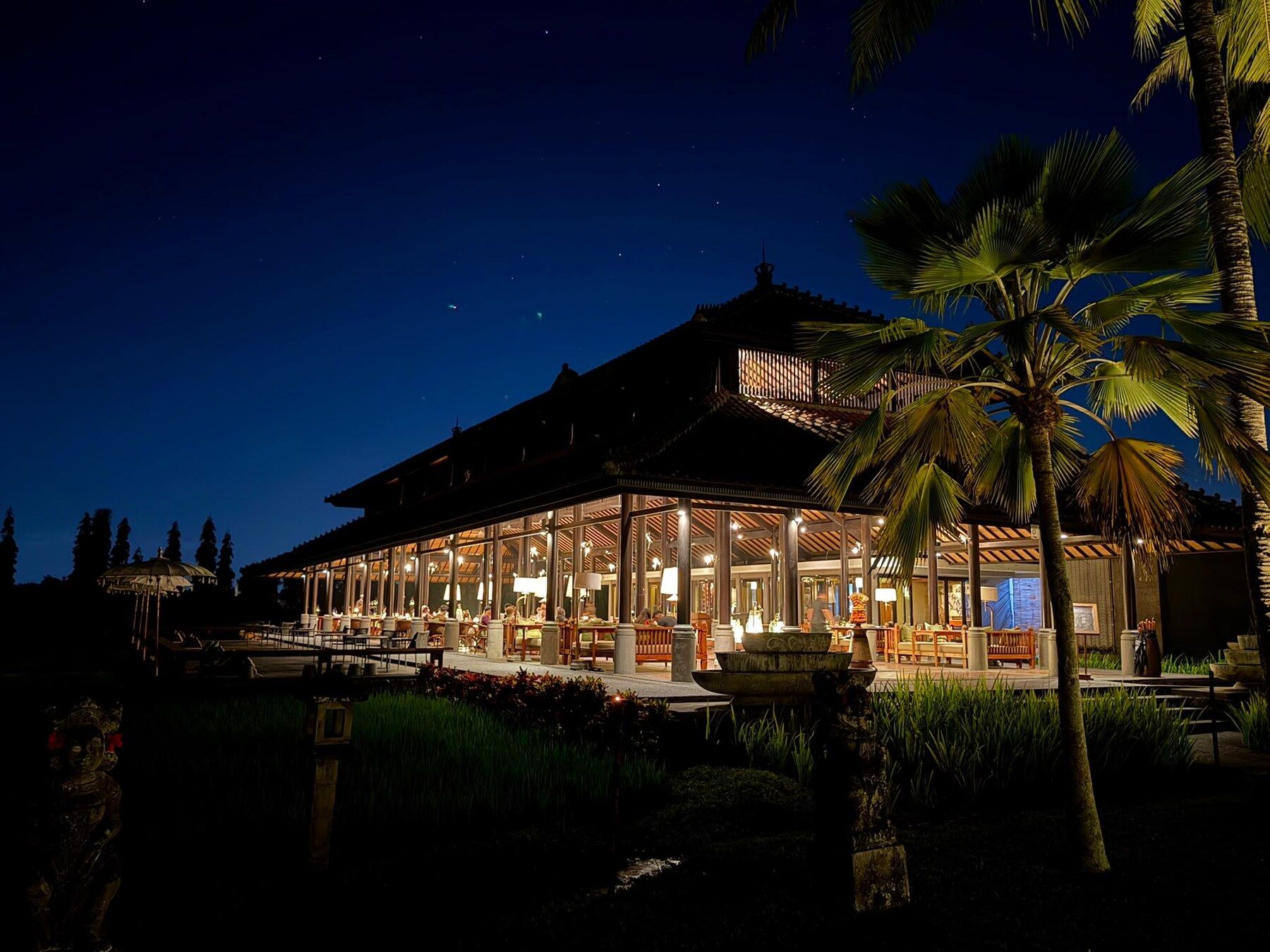
Peter Muller designed Amandari in eight days, and it opened a year later, in 1989, as the very first resort of its kind on the island. The infinity pool where I watched that parasol get quietly adjusted was Bali's first. Everything about the place, right down to its layout, was modelled on the traditional Balinese village next door in Kedewatan, not as a theme, but because that's genuinely what it is: paras-stone walls, a village gate at the entrance to each suite, alang-alang thatched roofs, pathways some locals still walk. Much of the staff, including the dancers I watched that afternoon, come from Kedewatan itself. It wasn't designed to feel authentic. It simply didn't need to try.
The rooms, and what I'd forgive them for
I stayed in a Village Suite, and it remains, without much competition, the best bedding I've ever slept in. As someone who has never particularly cared about bathtubs, I found something close to magic in the outdoor sunken marble bath tucked into my own private courtyard, open to the sky, the kind of detail reviews always call legendary and, for once, undersell.
I'll be honest about the one thing I'd flag: the rooms do feel a little dated in places. Old-style analogue switches, no television. As a romantic about this sort of thing, none of that bothered me in the slightest, but it's worth knowing before you book if you expect the polish of a newer property.
Prices, these days, sit surprisingly reasonably against Ubud's other top-tier names, Four Seasons Sayan, Como Shambhala, Mandapa. Which brings me to Mandapa specifically, because I can't write about Amandari without mentioning it. The two resorts sit in the same village, Kedewatan, overlooking the same stretch of the Ayung Valley, and Mandapa, to my eye, feels like a resort that studied Amandari's best ideas very closely and then refined them, right down to a valley view that feels almost lifted from Amandari's own. Given how close the two properties actually are, I genuinely wonder how they regard each other.
Everything within reach of the pool
One thing I've always appreciated about Amandari is how compact it is. Nearly everything sits around the main infinity pool, and that closeness gives the whole resort a genuine sense of togetherness that larger properties, however impressive, rarely manage. Nowhere is that clearer than at afternoon tea, included for every guest, no booking or dressing up required, people wander over straight from their sunbeds in whatever they were already wearing. It runs daily around four o'clock at the pavilion by the pool, the same stretch of afternoon when the village girls are practising their Legong a short walk away, so you often catch both at once, tea in hand, watching the lesson unfold. Two women from Kedewatan bring out traditional Balinese sweets and home-brewed tea and coffee, the kind of small, unforced ritual that ends up being one of the things I remember most fondly, simply because it brings everyone in the resort together in one place at the same time.
Where the kitchen isn't quite the point
If there's a place Amandari doesn't fully match its own standard, it's the kitchen. Not a dealbreaker, just not where the resort shines. I'd lean toward the simpler Indonesian and Balinese dishes on the menu rather than the wider card.
I still think about that parasol sometimes. Nobody needed to see it move. That's the whole point of the place.
Amandari is available through The Banjar Collective.
GET IN TOUCH TO PLAN A STAY →